
Introduction
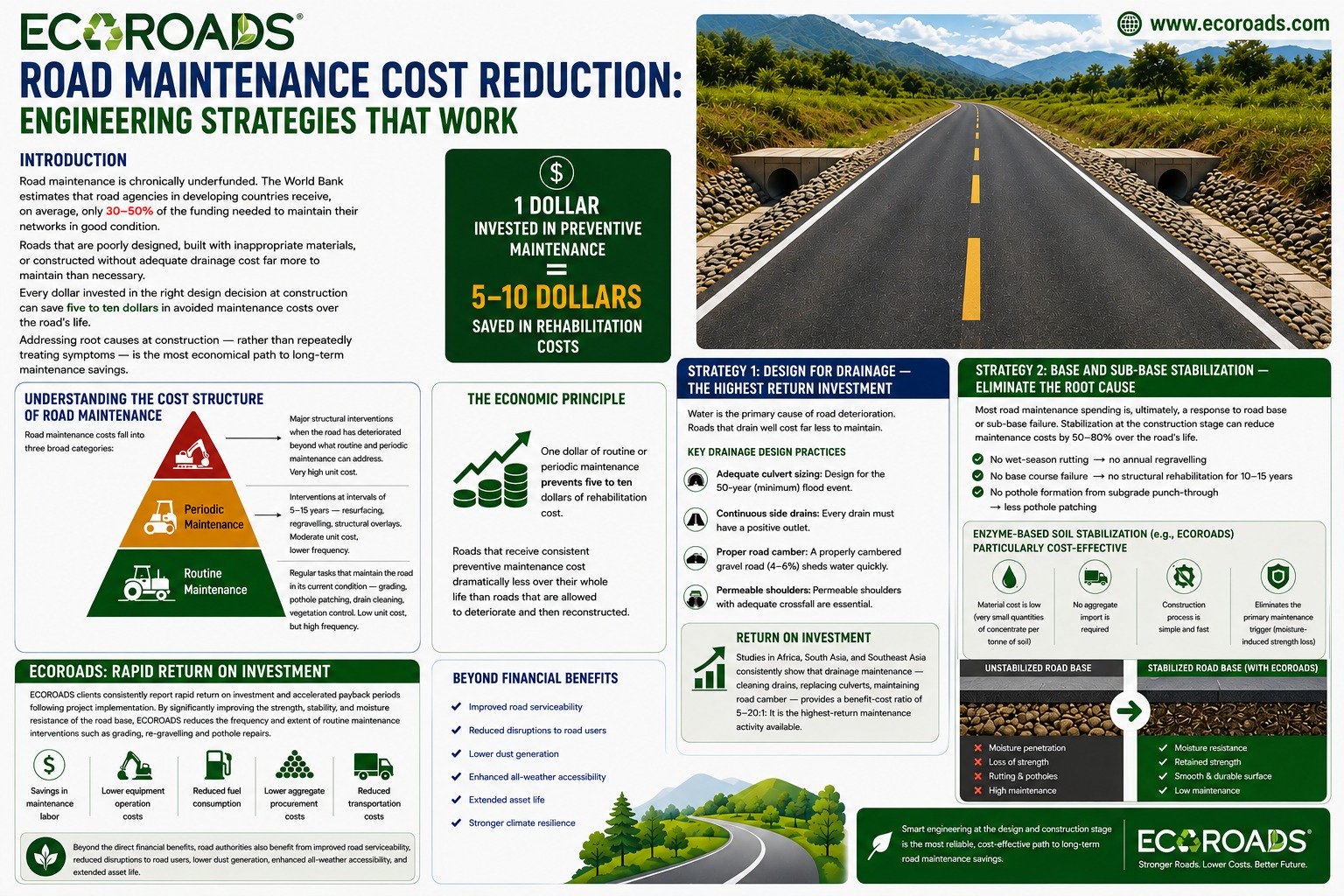
Road maintenance is chronically underfunded in most countries. The World Bank estimates that road agencies in developing countries receive, on average, only 30–50% of the funding needed to maintain their networks in good condition. The consequence is well-documented: roads deteriorate faster than they are maintained, rehabilitation backlogs grow, and the eventual reconstruction cost far exceeds what regular maintenance would have cost.
But road maintenance cost reduction is not simply a funding problem. It is also an engineering problem. Many roads cost far more to maintain than necessary because they were poorly designed, built with inappropriate materials, or constructed without adequate drainage. Every dollar invested in the right design decision at the construction stage can save five to ten dollars in avoided maintenance costs over the road’s life. Proven solutions such as the ECOROADS enzyme-based soil stabilization system demonstrate that addressing root causes at construction — rather than repeatedly treating symptoms — is the most economical path to long-term maintenance savings.
This article explores the most impactful strategies for reducing road maintenance costs — covering design, construction, and operations — with particular attention to the interventions that deliver the greatest return on investment.
Understanding the Cost Structure of Road Maintenance
Road maintenance costs fall into three broad categories:
- Routine maintenance: Regular tasks that maintain the road in its current condition — grading, pothole patching, drain cleaning, vegetation control. Low unit cost, but high frequency.
- Periodic maintenance: Interventions at intervals of 5–15 years — resurfacing, regravelling, structural overlays. Moderate unit cost, lower frequency.
- Rehabilitation and reconstruction: Major structural interventions when the road has deteriorated beyond what routine and periodic maintenance can address. Very high unit cost.
The fundamental economic principle of road maintenance is that one dollar of routine or periodic maintenance prevents five to ten dollars of rehabilitation cost. Roads that receive consistent preventive maintenance cost dramatically less over their whole life than roads that are allowed to deteriorate and then reconstructed.
Strategy 1: Design for Drainage — The Highest Return Investment
The single most cost-effective maintenance reduction strategy is adequate drainage design at the construction stage. Water is the primary cause of road deterioration. Roads that drain well cost less to maintain than roads that don’t — by a wide margin.
Key drainage design practices that reduce lifetime maintenance costs:
- Adequate culvert sizing: Undersized culverts overtop during major rainfall events, washing out embankments and pavements. The cost of one washout event typically exceeds the cost of upsizing the culvert by a factor of 10–50. Design for the 50-year (minimum) flood event.
- Continuous side drains: Side drains that do not connect to natural drainage outlets allow water to pond, infiltrate the formation, and soften the subgrade. Every drain must have a positive outlet.
- Adequate road camber: A properly cambered gravel road (4–6%) sheds water to the shoulders quickly. A flat or rutted road retains water in the wheel tracks, accelerating pothole formation and subgrade softening.
- Shoulder drainage: Sealed roads with sealed or unpermeable shoulders prevent edge drainage, trapping water in the base layers. Permeable shoulders with adequate crossfall are essential.
- Return on investment: Studies in Africa, South Asia, and Southeast Asia consistently show that drainage maintenance — cleaning drains, replacing culverts, maintaining road camber — provides a benefit-cost ratio of 5–20:1. It is the highest-return maintenance activity available.
Strategy 2: Base and Sub-Base Stabilization — Eliminate the Root Cause
Most road maintenance spending is, ultimately, a response to road base or sub-base failure. A weak, moisture-sensitive road base, loses strength seasonally, allowing the pavement to deform under traffic. The deformed pavement admits more water, accelerating further deterioration in a vicious cycle.
Breaking this cycle by stabilizing the road base and sub-base at the construction stage can reduce maintenance costs by 50–80% over the road’s life:
- No wet-season rutting → no annual regravelling
- No base course failure → no structural rehabilitation for 10–15 years
- No pothole formation from subgrade punch-through → less pothole patching
Enzyme-based soil stabilization — such as the ECOROADS stabilization solution — is particularly cost-effective for subgrade treatment because:
- Material cost is low (very small quantities of concentrate per tonne of soil)
- No aggregate import is required
- Construction process is simple and fast
- The treatment eliminates the primary maintenance trigger (moisture-induced strength loss)
ECOROADS clients consistently report rapid return on investment and accelerated payback periods following project implementation. By significantly improving the strength, stability, and moisture resistance of the road base, ECOROADS reduces the frequency and extent of routine maintenance interventions such as grading, re-graveling and pothole repairs. In many cases, the initial stabilization investment is recovered within a relatively short period through savings in maintenance labor, equipment operation, fuel consumption, aggregate procurement, and transportation costs.
Beyond the direct financial benefits, road authorities also benefit from improved road serviceability, reduced disruptions to road users, lower dust generation, enhanced all-weather accessibility, and extended asset life. These cumulative advantages make ECOROADS a highly cost-effective solution for municipalities, rural road agencies, mining operations, agricultural developments, and other organizations seeking to reduce life-cycle road infrastructure costs while improving long-term performance.
Strategy 3: Pavement Performance Management
- Establish a baseline: You cannot manage what you do not measure. Road agencies that track pavement condition systematically using simple visual surveys, roughness measurements (IRI), or DCP/deflection testing, can identify deterioration early, when intervention is still cheap.
- Prioritize early intervention: Pavement condition deteriorates slowly at first, then rapidly (the “S-curve” of road deterioration). Intervening when the road is at 70–80% of good condition is far cheaper than waiting until it has collapsed to 20–30%. A crack seal or light overlay applied at the right time costs $2–5 per m² compared to $30–60 per m² for structural rehabilitation.
- Segment-based planning: Maintain road segments that are genuinely worth maintaining. For roads that are structurally sound but have surface defects, preventive maintenance is appropriate. For roads with structural failure, throwing maintenance money at surface treatments is wasteful, the underlying problem must be addressed first. In many cases, this means treating the failed road base: a one-time ECOROADS stabilization treatment can restore structural integrity and halt the deterioration cycle, making subsequent surface maintenance effective again.
Strategy 4: Material Selection and Quality Control
The use of poor-quality road construction materials is one of the primary causes of premature deterioration of rural roads. Weak, poorly graded, or moisture-sensitive materials often lack the structural strength required to withstand traffic loads and environmental conditions, leading to rutting, erosion, potholes, and surface deformation. As a result, road authorities are forced to undertake more frequent maintenance and rehabilitation activities, significantly increasing life-cycle costs. Ensuring the use of stable, durable, and properly engineered materials is therefore essential for achieving long-lasting road performance and minimizing ongoing maintenance expenditures.
- Enforce material specifications: Test aggregate at the source quarry, not just on arrival at site. Ensure the contractor is not blending off-specification material to meet aggregate supply schedules.
- Upgrade marginal materials: Where better aggregate is unavailable or too expensive, stabilizing marginal laterite with enzyme treatment can bring it to specification — at lower cost than sourcing premium material from a distance. ECOROADS soil stabilization is specifically designed for this application: it can elevate marginal, locally available soils to meet base course and sub-base bearing requirements without aggregate import, significantly reducing both construction cost and long-term maintenance expenditure.
- Use locally appropriate specifications: Material specifications developed for high-volume roads in temperate climates may be too conservative for low-volume roads in tropical contexts. Using inappropriately tight specifications drives up cost unnecessarily; using inappropriately loose specifications increases maintenance cost. Specifications should be calibrated to the local environment and traffic conditions.
Strategy 5: Whole-Life Cost Analysis
Decisions about road design, material selection, and rehabilitation strategy should be made on a whole-life cost basis — not just upfront construction cost.
Life-cycle cost, rather than initial construction cost, is the true measure of road infrastructure value. Proper stabilization treatment that adds a modest cost per kilometer during construction but reduces annual maintenance costs by tens of thousands of dollars per kilometer offers an exceptional return on investment.
ECOROADS stabilization is designed to achieve precisely this outcome. By strengthening the road base and significantly reducing moisture-related deterioration, ECOROADS addresses the root cause of most rural road failures, resulting in lower maintenance requirements, extended service life, and substantial long-term savings.
Conclusion
Reducing road maintenance costs is not achieved through more frequent repairs—it is achieved by building roads that deteriorate more slowly in the first place. Sustainable cost reduction comes from a combination of sound engineering design, effective drainage systems, high-quality construction materials, strong asset management practices, and proactive maintenance strategies. Road authorities that focus on these fundamentals consistently achieve lower life-cycle costs, improved road performance, and longer service life.
Among all available interventions, proper drainage, road base and sub-base stabilization, and preventive maintenance programs consistently deliver the highest returns on investment. These measures address the underlying causes of pavement deterioration rather than simply treating visible surface defects after they appear. Numerous studies and field experiences worldwide have demonstrated that investments in these areas can generate benefit-to-cost ratios many times greater than their initial implementation cost.
Of these strategies, ECOROADS enzyme-based soil stabilization is particularly effective because it addresses one of the primary causes of road failure: weak, moisture-sensitive foundation materials. By improving the engineering properties of locally available soils, ECOROADS increases bearing capacity, reduces moisture susceptibility, enhances compaction efficiency, and creates a stronger, more durable road base and sub-base structure. This significantly reduces rutting, pothole formation, gravel loss, and structural deformation—the factors that drive the majority of road maintenance expenditures.
Unlike traditional approaches that often rely on importing large volumes of aggregate or repeated maintenance interventions, ECOROADS enables the use of in-situ materials, reducing construction costs, transportation requirements, and environmental impacts. The result is a road structure that requires less frequent grading, less re-graveling, fewer repairs, and substantially lower annual maintenance expenditure.
For road authorities, municipalities, mining operations, forestry companies, and rural infrastructure programs, the economic benefits are significant. Projects utilizing ECOROADS commonly report maintenance cost reductions of 60–80%, extended maintenance intervals, and rapid payback periods. Over the full life cycle of the road, these savings often exceed the initial stabilization investment many times over, making ECOROADS one of the most cost-effective and sustainable road asset management solutions available today.
In simple terms, the most economical road is not the one with the lowest construction cost, it is the one that delivers the lowest total cost of ownership over its entire service life. ECOROADS helps achieve exactly that by transforming weak local soils into a stronger, more resilient, and longer-lasting road foundation.