The post Soil Sieve Analysis and Its Role in Road Base Stabilization appeared first on TERRAROADS EQUIPMENT | EQUIPMENT FOR ROAD CONSTRUCTION AND MAINTENANCE.
]]>Every durable road begins not with the pavement surface visible to the traveling public, but with the base beneath it. Before any stabilizing agent — mechanical, chemical, or enzymatic — is introduced into a road base or subgrade, engineers must first understand the physical character of the material they are working with. The single most fundamental test used to characterize that material is the sieve analysis, also called a gradation test or particle size distribution (PSD) analysis.
This article explains what sieve analysis is, how it is performed, what the resulting data mean, and — most importantly for rural road construction — why gradation is one of the primary factors that determines whether a soil is a good candidate for enzyme-based stabilization with products such as ECOROADS. A soil’s particle size distribution influences its permeability, compaction behavior, strength development, and long-term durability once stabilized, making sieve analysis the starting point of virtually every road base design decision.
2. What Is Sieve Analysis?
Sieve analysis is a laboratory procedure used to determine the distribution of particle sizes within a soil sample. A typical soil sample is passed through a stack of sieves with progressively smaller square openings, arranged from largest opening at the top to smallest at the bottom, with a solid collection pan at the base. The stack is mechanically or manually shaken for a fixed duration, and the soil retained on each sieve is weighed. From these retained weights, the percentage of the total sample passing each sieve size is calculated, producing a particle size distribution curve.
The test is standardized internationally, most commonly under ASTM D6913 (Standard Test Methods for Particle-Size Distribution of Soils Using Sieve Analysis) and AASHTO T27, with a companion method — ASTM D7928 or the hydrometer method — used for the fine-grained fraction passing the No. 200 (75 micron) sieve, where individual particles are too small to separate mechanically.
2.1 Coarse and Fine Analysis
Sieve analysis is generally divided into two complementary procedures:
- Coarse (mechanical) sieve analysis — for particles retained on the No. 200 sieve, covering gravel and sand fractions, performed by dry or wet sieving through a graduated stack of sieves.
- Fine (sedimentation) analysis — for the silt and clay fraction passing the No. 200 sieve, typically performed using a hydrometer test that measures the settling velocity of particles suspended in water, since particles this small cannot be practically separated by screening.
For road base and sub-base evaluation, both fractions matter: the coarse fraction largely governs strength and drainage, while the fine fraction governs plasticity, moisture sensitivity, and the potential for chemical or enzymatic reactivity during stabilization.
2.2 Standard Sieve Sizes Used in Road Base Evaluation
| Sieve Designation | Opening Size | Material Retained |
|---|---|---|
| 3 in (75 mm) | 75.0 mm | Large gravel / cobbles |
| 3/4 in (19 mm) | 19.0 mm | Coarse gravel |
| 3/8 in (9.5 mm) | 9.5 mm | Fine gravel |
| No. 4 | 4.75 mm | Gravel / coarse sand boundary |
| No. 10 | 2.00 mm | Coarse sand |
| No. 40 | 0.425 mm | Medium sand |
| No. 100 | 0.150 mm | Fine sand |
| No. 200 | 0.075 mm | Sand / silt-clay boundary |
Table 1. Common sieve sizes referenced in AASHTO M147 and ASTM D6913 road base gradation specifications.
3. Test Procedure and Equipment
A standard sieve analysis follows a consistent sequence of steps, regardless of whether it is performed in a central laboratory or a field laboratory set up at a project site.
- Washing (if required): For soils with a significant fines content, the sample is washed over the No. 200 sieve to separate silt- and clay-sized particles adhering to coarser grains before dry sieving the retained material.
- Sample preparation: A representative sample is obtained by quartering or riffle-splitting a larger field sample, then oven-dried or open-air dried to a constant mass to remove moisture that would otherwise cause particles to clump.
- Stacking sieves: Sieves are arranged in descending order of opening size, with a pan at the bottom to catch material passing the finest sieve.
- Mechanical shaking: The stack is placed on a mechanical sieve shaker and agitated for a standard duration, typically 10 minutes, to ensure all particles reach their appropriate sieve.
- Weighing: The mass retained on each sieve, and in the pan, is recorded to the nearest 0.1 gram.
- Calculation: Cumulative percent retained and percent passing are calculated for each sieve size and plotted on a semi-logarithmic gradation curve.
Equipment required includes a graduated nest of sieves conforming to ASTM E11, a mechanical sieve shaker, an oven capable of maintaining up to 110°C, a balance accurate to 0.1 g, and, for the fine fraction, a hydrometer, sedimentation cylinder, and dispersing agent.
4. Interpreting the Gradation Curve
Once percent passing has been calculated for each sieve size, the results are plotted with particle diameter on a logarithmic x-axis and cumulative percent passing on a linear y-axis. The shape of this curve reveals critical information about the soil’s engineering behavior.
4.1 Well-Graded vs. Poorly-Graded Soils
A well-graded soil contains a broad, evenly distributed range of particle sizes, producing a smooth, gently sloping curve. Because smaller particles fill the voids between larger ones, well-graded soils compact to a higher density and develop greater interlocking strength — both highly desirable characteristics in a road base. A poorly-graded soil, by contrast, is dominated by a narrow range of particle sizes (uniformly graded) or is missing an intermediate size range entirely (gap-graded), producing a steep or irregular curve and leaving voids that reduce density and strength.
4.2 Coefficient of Uniformity and Curvature
Two numerical indices are derived directly from the gradation curve to classify grading quality:
- Coefficient of Uniformity (Cu) = D60 / D10 — the ratio of the particle diameter at 60% passing to that at 10% passing. Higher values indicate a broader size range.
- Coefficient of Curvature (Cc) = (D30)² / (D10 × D60) — describes the shape of the curve between D10 and D60.
For gravels, a Cu greater than 4 combined with a Cc between 1 and 3 typically indicates well-graded material; for sands, the Cu threshold is generally 6. These thresholds, defined in the Unified Soil Classification System (USCS), directly inform whether a base material will achieve adequate density under standard compaction effort.
5. Soil Classification Systems Derived from Sieve Data
Sieve analysis results feed directly into the two classification systems most widely used in road and geotechnical engineering: the Unified Soil Classification System (USCS, ASTM D2487) and the AASHTO Soil Classification System (AASHTO M145), used specifically for pavement subgrade and base evaluation.
5.1 AASHTO Classification
The AASHTO system groups soils from A-1 (excellent granular material) through A-7 (poor clay soils) based primarily on the percentage passing the No. 10, No. 40, and No. 200 sieves, combined with the Atterberg limits of the fine fraction. This classification directly correlates with a Group Index that predicts a soil’s suitability as a subgrade or base material without stabilization.
5.2 USCS Classification
USCS first divides soils into coarse-grained (more than 50% retained on the No. 200 sieve) and fine-grained (more than 50% passing the No. 200 sieve) categories, then further subdivides coarse-grained soils into gravels (GW, GP, GM, GC) and sands (SW, SP, SM, SC) based on gradation and fines plasticity. This two-letter symbol system gives engineers an immediate shorthand for a soil’s expected strength, drainage, and compaction behavior.
| USCS Symbol | Description | General Suitability as Road Base |
|---|---|---|
| GW | Well-graded gravel | Excellent — high density, strong interlock |
| GP | Poorly-graded gravel | Good — may need fines added |
| GM / GC | Silty / clayey gravel | Fair — moisture sensitivity increases |
| SW | Well-graded sand | Good — needs confinement |
| SP | Poorly-graded sand | Fair to poor — low interlock |
| SM / SC | Silty / clayey sand | Fair — stabilization often beneficial |
| ML / CL | Low-plasticity silt / clay | Poor unsterilized — good stabilization candidate |
| MH / CH | High-plasticity silt / clay | Poor — requires careful stabilization design |
Table 2. General road base suitability by USCS classification, prior to stabilization treatment.
6. Why Sieve Analysis Matters for Road Base Stabilization
Sieve analysis is not merely a classification exercise; it is the single data set that most directly determines whether, and how, a soil should be stabilized before it is placed as a road base or subgrade. Its importance falls into several practical categories.
6.1 Selecting a Stabilization Method
Different stabilization technologies respond to different particle size ranges. Cement and lime stabilization generally perform best on fine-grained soils with high plasticity, where pozzolanic reactions bind clay particles. Mechanical stabilization (blending) relies on combining gradations to achieve a well-graded mix. Enzyme-based stabilization, such as ECOROADS solution, depends on the presence of an adequate clay fraction — since enzymes catalyze bonding reactions with clay minerals and their associated cations — while also requiring enough granular material to provide a load-bearing skeleton once the fines are bound. Without a sieve analysis establishing the percentage passing the No. 200 sieve and the plasticity of that fraction, it is not possible to determine whether a soil has sufficient reactive fines for enzymatic treatment to succeed.
6.2 Predicting Compaction and Density
Gradation directly affects the maximum dry density and optimum moisture content obtained in Proctor compaction testing. A well-graded soil compacts more densely because smaller particles occupy the voids left by larger ones. Since stabilized strength is strongly correlated with achieved density, a favorable gradation curve, identified early through sieve analysis, increases confidence that target compaction and strength requirements can be met in the field.
6.3 Controlling Permeability and Moisture Sensitivity
The fines content and gradation shape determine how water moves through, and is retained within, the compacted base layer. Excess fines can trap moisture and reduce long-term strength, particularly in soils prone to swelling; insufficient fines can leave a base too permeable and prone to erosion or loss of fines under traffic loading. Enzyme stabilization works by altering the soil’s affinity for water at the particle level, but the gradation still governs how effectively that altered material can be compacted into a dense, low-permeability layer.
6.4 Establishing a Design and QC/QA Baseline
Sieve analysis performed during the design phase establishes the target gradation envelope for a project. During construction, periodic sieve testing of delivered or in-situ material against that envelope is one of the primary quality control checks used to confirm that the soil being stabilized still matches the design assumptions — particularly important on rural road projects where borrow sources or in-situ subgrade material can vary significantly along a project’s length.
6.5 Supporting Cost-Effective Rural Road Design
In rural and low-volume road contexts, budgets rarely allow for importing engineered base material over long distances. Sieve analysis of locally available soils allows engineers to determine whether in-situ or nearby borrow soil material can be stabilized in place, the core value proposition of enzyme-based products like ECOROADS, rather than defaulting to costly aggregate haulage. Accurately characterizing the local gradation is therefore central to both the technical and economic case for in-situ enzymatic stabilization.
7. Practical Gradation Screening for Enzyme Stabilization
Geotechnical evaluation generally requires plasticity testing alongside gradation, sieve analysis results can be used as an early, low-cost screening step to flag soils likely to respond well to enzymatic treatment.
- Fines content (passing No. 200) of roughly 15–35% is generally favorable, providing enough clay-sized material for enzymatic reaction while retaining a granular skeleton for load-bearing capacity.
- Very low fines content (below approximately 10%) typically indicates insufficient reactive material, and may require blending with a clay-rich borrow source before enzyme treatment.
- Very high fines content (above approximately 50%), especially combined with high plasticity, may require pre-treatment or gradation modification to avoid excessive shrink-swell behavior even after stabilization.
- A reasonably well-graded coarse fraction (favorable Cu and Cc values) supports higher achievable density once the fines are chemically bound, improving the stabilized layer’s long-term rutting resistance.
These ranges are general screening guidance, not a substitute for full laboratory evaluation and mix design testing specific to the project soil and ECOROADS® application rate.
8. Conclusion
Sieve analysis remains one of the foundational tests in road, road-base or sub-base engineering because it answers the first essential question in any stabilization program: What is the soil actually made of, and is its particle-size distribution suitable for stabilization? By determining the relative proportions of gravel, sand, and material passing the No. 200 sieve, the test supports soil classification and provides an initial indication of expected compaction behavior, permeability, drainage characteristics, workability, and load-bearing potential.
This information is particularly important when evaluating soils for treatment with ECOROADS soil stabilization solution. Unlike products that merely form a temporary coating on the road surface, ECOROADS works within a properly graded, compacted soil matrix and is most effective when the material contains a sufficient proportion of reactive cohesive fines, particularly clay particles. Sieve analysis helps identify whether the existing soil has an appropriate balance of coarse particles for structural stability and fine particles for effective stabilization. It can also reveal poorly graded materials, excessive gravel, or predominantly sandy soils that may require the addition of suitable cohesive material before treatment.
Because conventional sieve analysis does not distinguish clay from silt within the fraction passing the No. 200 sieve, it should be supplemented, where necessary, by hydrometer analysis, Atterberg limits, moisture-content testing, and a Proctor compaction test. Together, these results allow the project engineer to confirm suitability of local materials to achieve required result with ECOROADS solution treatment, determine whether soil blending or gradation correction is required, establish the optimum moisture content and maximum dry density, and develop an appropriate field application and compaction procedure.
For rural and remote road projects seeking to stabilize locally available soils in place, thorough particle-size analysis is therefore not simply an optional preliminary test. It is the technical foundation for selecting suitable material, minimizing the importation of aggregates, achieving the best result with ECOROADS solution treatment, and constructing a stronger, denser, more moisture-resistant, and longer-lasting road base.
References and Standards Cited
- ASTM D6913 — Standard Test Methods for Particle-Size Distribution (Gradation) of Soils Using Sieve Analysis
- ASTM D7928 — Standard Test Method for Particle-Size Distribution (Gradation) of Fine-Grained Soils Using the Sedimentation (Hydrometer) Analysis
- ASTM D2487 — Standard Practice for Classification of Soils for Engineering Purposes (Unified Soil Classification System)
- AASHTO T27 — Standard Method of Test for Sieve Analysis of Fine and Coarse Aggregates
- AASHTO M145 — Standard Specification for Classification of Soils and Soil-Aggregate Mixtures for Highway Construction Purposes
- AASHTO M147 — Standard Specification for Materials for Aggregate and Soil-Aggregate Subbase, Base, and Surface Courses
The post Soil Sieve Analysis and Its Role in Road Base Stabilization appeared first on TERRAROADS EQUIPMENT | EQUIPMENT FOR ROAD CONSTRUCTION AND MAINTENANCE.
]]>The post Road Construction in Remote Areas: Engineering Strategies and the ECOROADS Advantage appeared first on TERRAROADS EQUIPMENT | EQUIPMENT FOR ROAD CONSTRUCTION AND MAINTENANCE.
]]>Remote-road construction success depends on converting local soils into dependable infrastructure without relying on imported materials, expensive specialized equipment, or significant environmental impact.ECOROADS is purpose-built for that challenge.
Introduction
Building roads in remote areas is fundamentally different from urban or suburban construction. Distance removes the safety net of nearby quarries, ready-mix plants, equipment dealers, specialist subcontractors, and rapid maintenance support. Every decision—from pavement thickness and drainage to material selection and construction methodology—has greater financial and operational consequences because correcting a mistake far from established supply chains is exceptionally expensive.
At the same time, remote roads are essential to mining, agriculture, forestry, energy development, emergency access, and community connectivity. These projects therefore require an engineering approach that delivers dependable performance without assuming unlimited access to imported aggregate, cement, lime, fuel, or heavy transport.
ECOROADS enzyme-based soil stabilization product directly supports this approach. Rather than treating locally available soil as waste that must be removed, use of ECOROADS product helps convert suitable fine-grained and cohesive soils into a dense, strong, and durable road base or sub-base. The result is a road strategy built around local resources, simpler logistics, standard construction equipment, and lower whole-project impact.
The Core Challenge: Material Logistics
The defining constraint in remote road construction is often not the availability of engineering knowledge; it is the cost, time, and uncertainty involved in moving large quantities of material to the site. Imported aggregate, cement, and lime may require hundreds or thousands of truck movements. Each movement adds freight cost, fuel consumption, road wear, emissions, scheduling risk, and exposure to weather or supply-chain interruptions.
This changes the design question. Instead of asking only, “What is the technically ideal imported material?”, the project team must also ask, “How can we achieve the required performance with the materials already available along the road location?”
The most effective solution is therefore one that transforms suitable local soil into a dependable structural asset.
ECOROADS soil stabilization product supports this approach by enabling project teams to construct a strong, durable, and economical road base using predominantly in-situ materials. Its concentrated formulation, straightforward application, and compatibility with standard road-building equipment help reduce imported materials, transportation movements, logistical complexity, and long-term maintenance demand—making it particularly well suited to challenging and isolated locations.
Strategy 1: Make Local Soil the Primary Construction Material
The strongest cost-control strategy for a remote roads construction or renovation is to maximize the engineered use of materials already present at or near the site. ECOROADS makes this possible in several ways:
- Treat the in-situ base or sub-base. Instead of excavating weak soil and replacing it with imported aggregate, or introducing bulk lime or cement, suitable soil can be pulverized, treated with diluted ECOROADS solution, mixed, shaped, and compacted in place.
- Upgrade marginal local material. Fine-grained, cohesive, and many lateritic soils that do not meet untreated pavement specifications may be improved through stabilization, reducing the need to search for distant gravel sources or open new borrow pits.
- Reduce excavation, disposal, and replacement. Retaining suitable soil within the road structure reduces hauling in both directions: less unsuitable material must be removed, and less replacement material must be delivered.
- Support road rehabilitation. Where an existing unsealed road or soil-based pavement is being rebuilt, the available material can often be reprocessed and incorporated into a new stabilized layer, subject to confirmation that the final blend has the required soil composition.
This local-material approach must begin with appropriate testing. Soil gradation, clay and fines content, plasticity, moisture-density relationships, and bearing capacity should be evaluated before finalizing dosage and layer design.
Strategy 2: Design the Pavement for Its Actual Purpose
Remote roads often carry lower traffic volumes than the primary roads they connect to, although mining and industrial haul roads may carry fewer but much heavier vehicles. Applying urban highway standards indiscriminately can create excessive layer thicknesses, unnecessary imported-material demand, and construction costs that do not correspond to the road’s real function.
- Right-size the structural section. Determine the stabilized layer thickness from expected axle loading, traffic volume, subgrade strength, climate, drainage, and the verified properties of the treated soil.
- Design from tested treated-soil values. Laboratory testing allows the designer to evaluate the improvement achieved with ECOROADS product and use those results in the pavement design rather than relying only on the untreated soil classification.
- Match the wearing surface to risk. Depending on traffic, rainfall, gradients, and safety requirements, the stabilized layer may support an unsealed road, a gravel dressing, a chip-seal, or a conventional paved surface.
- Design for maintainability. A remote road should minimize routine reshaping, material replacement, dust-control treatments, and emergency repairs. A well-compacted ECOROADS-treated layer can improve long-term structural stability and reduce the rate at which fines and surface material are lost.
Strategy 3: Treat Drainage as Part of the Stabilization System
Poor drainage remains one of the most common causes of premature road failure. Stabilization substantially improves the road material, but it does not eliminate the need to control surface water, groundwater, erosion, and concentrated runoff.
- Build an effective crown or crossfall so rainfall leaves the running surface quickly.
- Establish continuous roadside drainage channels and stable outlets that prevent water from ponding at the pavement edge.
- Provide adequately sized culverts and erosion protection based on catchment conditions and expected extreme rainfall.
- Elevate the formation where seasonal saturation or a high water table threatens the road structure.
- Use a suitable wearing surface where high rainfall, steep grades, or traffic safety require additional protection.
The best performance is achieved when ECOROADS stabilization and drainage are designed as one system: the treated layer provides density, strength, and resistance to material loss, while the drainage network prevents prolonged saturation and risk of erosion.
Strategy 4: Use a Controlled, Phased Construction Process
A phased approach reduces technical and financial risk, particularly when equipment, funding, and trained personnel must be mobilized over long distances.
- Confirm soil suitability and design parameters. Complete representative sampling and laboratory testing, then establish the approved dosage, compacted layer thickness, moisture target, and quality-control requirements.
- Prepare, treat, and compact the structural layer. Scarify or pulverize the soil, dilute ECOROADS in clean water, distribute it uniformly, mix thoroughly, shape the road, and compact promptly with appropriate equipment.
- Complete the drainage system. Construct the crown, shoulders, side drains, culverts, outlets, and erosion-control measures needed to protect the stabilized road.
- Allow initial curing and protect the work. Restrict traffic during the initial curing period and avoid application during unsuitable weather or immediately before heavy rain.
- Apply the selected surface treatment. Once the stabilized layer has been accepted, add a gravel dressing, chip-seal, or pavement surface when required by the project design.
This sequence allows the road to be delivered in manageable stages while preserving quality control. It also enables the project team to validate productivity and treated-soil performance before expanding construction across long distances.
Strategy 5: Use ECOROADS to Reduce the Remote-Project Burden
ECOROADS offers a combination of benefits that is especially valuable where access, transport capacity, equipment availability, and maintenance support are limited.
- Exceptional transport efficiency. The highly concentrated liquid formulation requires only a fraction of the transport volume associated with imported aggregate, cement, or lime. This reduces freight cost, vehicle movements, fuel use, unloading, storage, and exposure to delivery delays.
- Productive use of local soil. Suitable in-situ material becomes a construction asset, reducing dependence on quarries, borrow pits, imported gravel, and material-replacement operations.
- Standard construction equipment. ECOROADS can be applied with equipment commonly used for roadwork: a grader, a water tanker, and an appropriate compactor. No specialized chemical-spreading equipment is required.
- Faster and simpler project mobilization. Smaller product volumes are easier to procure, ship, store, secure, and distribute along an extended road corridor, helping the project begin sooner and maintain steady production.
- Lower total construction cost. Savings can result from reduced imported material, fewer truck movements, less excavation and disposal, shorter construction cycles, lower equipment hours, and decreased maintenance demand.
- Improved engineering performance. When applied to suitable soil and compacted correctly, ECOROADS can increase density, bearing capacity, strength, and resistance to deformation and moisture-related deterioration. Treated layers may continue to develop strength after construction.
- Long-term dust and material-loss reduction. By strengthening the bond between fine soil particles within the treated layer, ECOROADS addresses a major cause of dust generation and surface ravelling rather than providing only a temporary surface treatment.
- Safer and more environmentally responsible handling. ECOROADS is a biomass-based, biodegradable, non-caustic, non-corrosive, and non-combustible product. It avoids much of the dust and bulk-material handling associated with cement and lime and can reduce the carbon footprint created by material extraction and long-distance hauling.
- Scalability. The same core process can support a small community access road, an agricultural route, or a large infrastructure program, provided that soil suitability, pavement design, drainage, and construction quality are confirmed for the specific project.
Equipment and Quality Control for Remote Construction
ECOROADS reduces the material-supply burden, but successful stabilization still depends on disciplined preparation, uniform mixing, correct moisture, and effective compaction. A typical equipment set includes:
- A motor grader for scarifying, blending, shaping, and maintaining the road profile.
- A calibrated water tanker or spray system for uniform distribution of the diluted ECOROADS solution.
- An appropriate 12–14-ton steel-drum or padfoot roller selected for the soil type and layer thickness; a heavy steel roller is commonly used for final density and surface finish.
- Basic field-control equipment for monitoring moisture content, layer thickness, treatment coverage, and achieved density.
- Critical spare parts and trained local operators to reduce downtime where outside mechanical support is difficult to obtain.
Community and Workforce Benefits
In-situ stabilization can keep a greater share of project spending within the local economy. Because the process relies heavily on local soil and standard road-building equipment, it can support local employment, equipment hire, water supply, drainage work, traffic management, and ongoing maintenance.
- Reduce equipment and material mobilization costs.
- Create local employment and income during preparation, drainage, construction support, and maintenance.
- Develop transferable skills in soil preparation, moisture control, compaction, drainage, and road upkeep.
- Strengthen community ownership by building the road with local labor and locally available materials.
Mechanical mixing and compaction remain essential for consistent quality, but many preparatory, drainage, finishing, and maintenance activities can be organized through local contractors and labour-based teams.
Project Controls That Protect Performance
The full benefit of ECOROADS soil stabilization is achieved when product application is integrated with sound engineering and construction control. The following requirements should be treated as essential:
- Verify that the soil contains the appropriate balance of fines and cohesive material; ECOROADS® is not intended to stabilize pure sand.
- Use project-specific laboratory testing to establish the treatment dosage, target moisture, compacted density, and expected strength improvement.
- Mix the diluted product uniformly through the full design depth and complete compaction promptly.
- Construct during a suitable dry-weather window and protect the treated layer during its initial curing period.
- Provide effective drainage and an appropriate wearing surface for the traffic, climate, gradients, and safety conditions.
Conclusion: ECOROADS is purpose-built for Remote Road Construction
Successful road construction in remote areas requires a different mindset from conventional urban highway engineering. The most important design decision is often logistical as well as structural: how to build the strongest, most durable, and most economical road while importing the fewest possible tons of material and minimizing transport, fuel, equipment, and maintenance demand.
For remote communities and infrastructure developers, this is the decisive advantage of ECOROADS: instead of effectively transporting an entire road to the project site in the form of truckloads of aggregate, cement, lime, and other imported materials, project teams can transform suitable local soils into a strong, compacted, and durable road base. Because ECOROADS is supplied as a highly concentrated liquid and can be applied using standard road-construction equipment, it substantially reduces material transportation, fuel consumption, heavy-truck movements, logistical complexity, construction costs, and environmental impact. This makes it possible to build higher-quality roads faster and more efficiently, even in isolated locations where access is difficult and conventional material supply chains are costly or unreliable..
The post Road Construction in Remote Areas: Engineering Strategies and the ECOROADS Advantage appeared first on TERRAROADS EQUIPMENT | EQUIPMENT FOR ROAD CONSTRUCTION AND MAINTENANCE.
]]>The post Controlling Road Dust at the Source: Dust Suppression Through In-Situ Soil Stabilization appeared first on TERRAROADS EQUIPMENT | EQUIPMENT FOR ROAD CONSTRUCTION AND MAINTENANCE.
]]>Unpaved and gravel roads form the backbone of rural connectivity across much of the world, linking farms to markets, villages to clinics, and communities to schools. Yet every vehicle that travels these routes grinds the road surface into a fine suspension of silt and clay particles that lifts into the air behind it. This airborne dust is far more than a visibility nuisance. It represents the steady, invisible loss of a road’s finer material — the very particles that give the running surface its cohesion and load-bearing capacity.
Over a single dry season, a heavily trafficked rural road can lose a measurable fraction of its top course fines to dust generation alone. The consequences compound quickly: raveling and washboarding accelerate, potholes form sooner, and the road requires more frequent re-grading — all while the surrounding environment absorbs airborne particulate that affects crop growth, respiratory health, and the safety of drivers navigating reduced visibility.
Dust suppression, then, is not a cosmetic exercise. It is fundamentally a soil-conservation and structural-durability problem, and the most durable answer treats it as one.
2. Why Conventional Dust Palliatives Fall Short
Road authorities and contractors have relied on a familiar toolkit for decades: periodic water spraying, hygroscopic salts such as calcium or magnesium chloride, and surface applications of polymer solutions or bitumen emulsion. Each of these can reduce dust in the short term, but each also treats the symptom rather than the cause.
Water spraying suppresses dust for only a few hours before evaporation and traffic re-pulverize the surface, making it the most water- and labor-intensive option with no lasting structural benefit. Chloride salts extend that window to weeks or months by drawing moisture from the air, but they are corrosive to vehicles and infrastructure, contribute to roadside vegetation stress, and wash out during heavy rain, requiring repeated reapplication. Bitumen and asphalt surface treatments last longer but demand paving-grade equipment, skilled crews, and imported binder — costs that place them out of reach for many rural and municipal road programs, particularly on low-volume networks where the return on investment is hardest to justify.
What all of these approaches share is a focus on the surface. They coat or wet the top few millimeters of road material without altering the fundamental particle-to-particle bonding within the soil matrix itself. Because the underlying material remains loose and dust-prone, the palliative effect is inherently temporary.
3. In-Situ Soil Stabilization: Treating the Cause, Not the Symptom
In-situ soil stabilization takes a different approach, rather than adding a wearing course or a temporary surface coating, it modifies the chemical and physical behavior of the native road soil itself, using materials already present at the site wherever possible. The process typically follows four steps — crushing the existing road material to design depth, introducing a stabilizing agent, blending it thoroughly through the loosened material, and recompacting the mixture to target density before final shaping.
The stabilizing mechanism most relevant to dust control is the reduction of the fine-particle fraction’s tendency to detach under traffic loading. Clay and silt particles in untreated soil are held together primarily by weak electrostatic and moisture-dependent forces; as the road dries and vehicles apply repeated shear stress, these bonds break down and particles become airborne. A properly designed stabilization treatment permanently alters that particle interaction, producing a denser, more cohesive matrix that resists abrasion and disaggregation even as the surface dries.
3.1 Enzyme-Based Stabilization Chemistry
Among in-situ methods, enzyme-based stabilization, like use of ECOROADS product, has gained adoption specifically because it addresses dust formation at the mineralogical level without the drawbacks associated with cementitious or chloride-based treatments. Enzyme formulations act as organic catalysts that accelerate the natural cation-exchange and flocculation processes already present in clay-bearing soils. Applied as a diluted solution during mixing and compaction, the enzyme-based solution promotes stronger bonding between clay particles and the surrounding aggregate matrix. This reduces interparticle voids and prevents fine particles from loosening and becoming airborne.
The enzyme-based solution promotes bonding that is permanent and occurs within the soil structure rather than forming a temporary surface film. Unlike temporary surface treatments, ECOROADS product works within the soil structure to create permanent bonding between clay and fine particles and the surrounding aggregate matrix. This provides long-lasting dust control that withstands heavy rain, high temperatures, and repeated traffic. When applied to soils containing sufficient clay and fines, the enzyme-based formula works effectively to stabilize the soil, prevent particles from becoming airborne, and reduce the need for frequent watering, reapplication, and maintenance.
3.2 Structural and Environmental Co-Benefits
A key advantage of treating dust pollution through soil stabilization rather than surface palliation is that the same treatment that suppresses dust also improves the road’s structural performance. Stabilized layers exhibit higher California Bearing Ratio (CBR) values, greater resistance to moisture-induced softening, and reduced rutting and washboarding under repeated traffic loading. Because the treatment uses the existing road material rather than imported aggregate, it also reduces the haulage traffic, fuel consumption, and quarrying pressure associated with conventional re-graveling programs — an environmental benefit that compounds the direct air-quality gains from reduced dust emission.
4. Field Implementation: From Diagnosis to Compaction
Effective dust suppression through stabilization depends on a disciplined field process rather than simply applying product to an existing surface. The sequence below reflects standard practice for enzyme-based in-situ treatment of unpaved rural roads.
4.1 Soil Characterization
Before treatment, soil material samples are tested for grain-size distribution, Atterberg limits (liquid limit, plastic limit, and plasticity index), and clay mineralogy. This step determines whether the parent soil contains sufficient reactive fines to bond effectively and informs the required application rate. Soils that are predominantly coarse sand or gravel with minimal fines may need blending with an imported clay source before stabilization can achieve a dust-resistant matrix.
4.2 Pulverization and Shaping
The existing road material is scarified and pulverized to the specified treatment depth — commonly 200 millimeters for rural gravel roads — using a conventional road grader or reclaimer, or agricultural disc harrow where specialized equipment is unavailable. Oversized material and organic debris must be removed, and the road profile is shaped to design cross-fall to ensure surface drainage once the treatment is complete.
4.3 Enzyme Application and Moisture Conditioning
The enzyme concentrate is diluted with water according to the manufacturer’s application rate and applied uniformly across the pulverized layer, typically via water tanker with a calibrated spray bar. Moisture content is brought to within a defined range of the soil’s optimum moisture content (as determined by a Proctor compaction test) to ensure the enzyme solution penetrates and reacts throughout the full treatment depth rather than remaining concentrated near the surface.
4.4 Mixing
Thorough blending of the enzyme solution through the full depth of pulverized material is the single most important determinant of treatment success. Inadequate mixing produces localized zones of untreated soil that remain dust-prone and structurally weak, undermining the uniformity of the finished road. Multiple passes with a reclaimer or rotavator are typically required to achieve visually consistent color and moisture distribution.
4.5 Compaction
The treated layer is compacted in lifts using a vibratory smooth-drum or padfoot roller to achieve at least 98 percent of maximum dry density at the target moisture content. Compaction must occur promptly after mixing, before the enzyme reaction and moisture loss reduce workability. Final passes with a smooth-drum roller establish the finished riding surface and close any surface voids that could otherwise become dust-generation points.
4.6 Curing
Following compaction, the road is typically closed to traffic for 48-72hours curing period, allowing the enzyme-driven bonding reaction to progress before the surface is exposed to full traffic loading. Light water curing may be applied in hot, dry climates to prevent premature surface desiccation during this window.
5. Quality Control and Verification
A dust-suppression treatment is only as reliable as the quality control regime behind it. Field density testing (nuclear gauge or sand-cone method) confirms compaction targets are met across the treated length, while periodic moisture testing during construction verifies the layer was within the specified range at the time of compaction. Post-construction, visual dust-generation assessment under representative traffic conditions — commonly compared against an untreated control section — provides a practical field verification that the stabilization has achieved its intended purpose, alongside laboratory CBR and durability testing on retained samples.
6. Comparative Summary
The table below situates in-situ soil stabilization within the broader set of dust-control options available to road authorities, highlighting the trade-off between short-term convenience and long-term durability that underlies the case for a structural, rather than palliative, approach to dust.
| Dust Control Method | Typical Effective Life | Key Limitation |
|---|---|---|
| Water spraying | Hours (daily reapplication) | High recurring cost; water scarcity; no strength gain |
| Calcium/magnesium chloride | 2-3 months | Corrosive to vehicles; leaches in rainfall, creates harmful to health dust |
| Polymer/chemical surface prime | 1-2 months | Harmful for surrounding environment, leaches in rainfall, creates harmful to health dust |
| Bitumen/asphalt emulsion prime | 1–3 years | High material cost; requires paving-grade equipment, high maintenance cost |
| Cement/lime stabilization | Several years | Brittle surface cracking; harmful for surrounding environment, high carbon footprint; high material cost, costly hauling of binder |
| Enzyme-based in-situ stabilization (e.g., ECOROADS) | 3–7+ years, renewable by re-compaction | Requires adequate fines/clay fraction in parent soil; |
Table 1. Comparative effective life and limitations of common dust-suppression methods.
7. Conclusion
Dust on unpaved rural roads is a visible symptom of an underlying structural problem: the gradual loss of the fine particles that hold a road surface together. Palliative treatments — water, chloride salts, or surface-applied chemical or bitumen binders — can mask this symptom temporarily, but only in-situ soil stabilization addresses the cause by permanently strengthening the bond between soil particles at the depth where dust originates. Enzyme-based treatments, such as ECOROADS product, applied through a disciplined pulverize-mix-compact process, offer road authorities and rural communities a way to achieve durable dust suppression and structural improvement simultaneously, using the soil already present at the roadside rather than costly imported materials. For road authorities and rural communities facing limited budgets and increasing traffic, ECOROADS delivers multiple long-term benefits: effective dust suppression, cleaner air, improved visibility, a more stable road surface, lower maintenance requirements, and an extended service life.
The post Controlling Road Dust at the Source: Dust Suppression Through In-Situ Soil Stabilization appeared first on TERRAROADS EQUIPMENT | EQUIPMENT FOR ROAD CONSTRUCTION AND MAINTENANCE.
]]>The post Low-Volume Road Design: Engineering Principles for Cost-Effective Rural Infrastructure appeared first on TERRAROADS EQUIPMENT | EQUIPMENT FOR ROAD CONSTRUCTION AND MAINTENANCE.
]]>Low-volume roads serve the majority of the world’s population and carry a disproportionate share of the world’s social and economic value. A road connecting a farming community to a market, a clinic to a district hospital, or a school to the children who depend on it may carry only 50 vehicles a day — but its value to those communities is immeasurable.
Yet low-volume roads are frequently the least well-designed roads in any network. They are often designed by copying standards developed for heavy-traffic highways, scaled down by intuition rather than engineering analysis. The result is roads that are either over-designed (wasting scarce resources) or under-designed (failing within years). Both outcomes represent a failure of engineering.
This article presents the core engineering principles for low-volume road design — building roads that are structurally adequate, cost-effective, appropriate to the context, and durable enough to deliver value over a realistic design life.
Defining “Low-Volume Road”
For design purposes, a low-volume road typically refers to a road carrying fewer than 300–500 vehicles per day (VPD) and accumulating fewer than 1 million Equivalent Standard Axles (ESA) over a 10–20 year design life. This category includes:
- Community and village access roads
- Agricultural service and haul roads
- Rural feeder roads in developing country networks
- Secondary and tertiary roads in remote areas
- Mining and forestry access roads (where vehicle types are known)
The design challenges on these roads are distinct from those on high-volume infrastructure. The governing failure mode is rarely fatigue — it is more commonly:
- Subgrade softening in wet seasons
- Surface erosion and pothole formation
- Embankment instability
- Drainage failure
Design methods and standards should reflect these realities.
Principle 1: Know Your Subgrade
The single most important design decision on a low-volume road is the design of road base and sub-base layers, and whether they will be treated. Most low-volume road failures begin at the base or sub-base level: a soil mix materials that performs adequately during construction becomes saturated in the first wet season and loses the strength that the pavement design relied on.
- Step 1: Conduct systematic CBR testing of local soil materials along the project, at intervals of 200–500 m, to characterize base and sub-base variability. Use the 85th percentile value as the design CBR (meaning 85% of the road length has this CBR or higher).
- Step 2: Evaluate whether the in-situ base, or sub-base material provides sufficient CBR to satisfy the pavement design requirements. If the measured CBR is below the design target, soil stabilization should be considered. As a general guideline, sealed low-volume roads typically require a minimum soaked base-layer CBR of CBR ≥ 50%, while unsealed low-volume roads generally require a minimum soaked base-layer CBR of 25–30%, subject to project-specific traffic loading and applicable design standards.
- Step 3: If stabilization is required, select the most appropriate method based on the soil type, project requirements, environmental conditions, and available budget. For cohesive soils, enzyme-based stabilization is often the most cost-effective solution, typically increasing the CBR by 3 to 10 times while significantly reducing construction costs compared with conventional road base or sub-base construction using imported gravel, lime, or cement.
Principle 2: Design for the Wet Season
Low-volume road design must be governed by worst-case conditions — not average conditions or dry-season construction conditions.
The design pavement structure must be thick enough to protect the road base from exceeding its strength under traffic loading during the wet season. This is often the critical loading condition — traffic loads may be light, but if they are applied to a saturated, softened base, the result is progressive failure.
Design methods such as AUSTROADS Part 2, TRL Road Note 31, and AASHTO Low-Volume Roads Guide provide procedures for relating design traffic (ESA), design for road base and sub-base, and material quality to the required pavement thickness.
Principle 3: Drainage is Structure
Drainage is not an afterthought in low-volume road design — it is an extremely important structural element. A well-drained road with a modest pavement thickness will outperform a thick pavement with poor drainage every time.
Design priorities:
- Adequate road camber: The finished road surface should have a cross-fall of 3–5% for sealed roads and 4–6% for unsealed roads, directing water to the shoulders and into drains.
- Continuous side drains: Side drains must have a positive outlet at every section. A side drain that cannot discharge creates ponding that infiltrates the formation.
- Appropriately sized culverts: Size for at least the 25-year rainfall event on rural roads, 50-year for important crossings. Undersized culverts are one of the most common causes of premature road failure.
- Road elevation: Where possible, the road formation should be elevated above the seasonal water table and surrounding terrain, minimizing the risk of subgrade inundation.
- Vegetation and erosion control: Embankment slopes should be protected with appropriate vegetation (local grasses or vetiver) to prevent erosion and maintain slope stability.
Principle 4: Appropriate Material Specifications
Material specifications for low-volume roads should be calibrated to the traffic and environment, not copied from highway standards. Using unnecessarily tight specifications drives up cost without improving performance. Using inappropriately loose specifications causes premature failure.
- Subgrade: Treated or untreated soaked CBR ≥ 5–10% (as specified by design method)
- Sub-base (where used): Gravel or stabilized material, soaked CBR ≥ 25–30%, PI ≤ 12
- Base course (stabilized): UCS target at 28 days ≥ 1.0–2.0 MPa (cement-treated), or CBR ≥ 50% (enzyme or other stabilization treated)
- Wearing course (gravel): CBR ≥ 20%, PI between 4 and 12, maximum aggregate size ≤ 37.5 mm
Principle 5: Pavement Structure Selection
For low-volume roads, several pavement structure types are appropriate:
Granular road with gravel wearing course (unsealed):
- Base course (stabilized or natural, CBR ≥ 50%)
- Gravel wearing course 100–200 mm
Appropriate for <50 VPD; requires regular grading and periodic re-gravelling.
Granular road with bituminous seal:
- Base course (stabilized or natural, CBR ≥ 50%)
- Prime coat
- Single or double chip seal
Appropriate for 50–300 VPD; requires periodic resealing every 7–12 years.
Stabilized road with bituminous seal:
- Stabilized base 150–250 mm (enzyme, lime, or cement treated in-situ soil, CBR ≥ 50% )
- Prime coat
- Single or double chip seal
Most cost-effective for remote areas; eliminates aggregate import; appropriate for 50–300 VPD.
Thin asphalt on stabilized base:
- Stabilized base 150–200 mm ( CBR ≥ 50%)
- Asphalt wearing course 25–40 mm
Higher upfront cost; lowest maintenance cost; appropriate for 200–500 VPD on important routes.
Principle 6: Design for Maintainability
A road that is cheap to build but impossible to maintain without specialist equipment or large budgets is poorly designed. Low-volume road design should explicitly consider:
- Can the wearing surface be maintained with locally available equipment (grader, roller, water tanker)?
- Is the surface treatment type compatible with locally available maintenance resources?
- Are drainage structures simple enough to be cleaned and maintained by local communities?
- Can the stabilized base be repaired locally if damaged by an extreme weather event?
Maintenance simplicity and local resource compatibility are genuine engineering considerations — not luxuries.
Conclusion
Low-volume road design is a specialized engineering discipline that requires the integration of geotechnical engineering, pavement engineering, hydrology and drainage design, materials engineering, and practical construction management. Unlike high-volume highways, the success of low-volume roads depends less on expensive imported materials and more on a thorough understanding of local soil conditions, climate, drainage, and appropriate construction techniques.
A well-designed low-volume road maximizes the use of locally available materials, minimizes construction and maintenance costs, and provides a durable, reliable transportation corridor capable of serving communities for decades. Proper site investigation, accurate soil characterization, effective drainage, appropriate pavement design, and quality construction practices all play a critical role in achieving long-term performance. When combined with modern soil stabilization technologies, such as ECOROADS enzyme-based stabilization where appropriate, engineers can significantly improve the strength and durability of existing native soils while reducing dependence on costly imported aggregates and other traditional stabilizing agents.
Conversely, inadequate design, poor drainage, insufficient understanding of soil behavior, or improper construction practices can lead to premature pavement deterioration, excessive maintenance requirements, and unnecessary reconstruction costs. Roads that fail within only a few years not only waste limited financial resources but also disrupt transportation, economic development, and access to essential services for the communities that depend on them.
By applying sound engineering principles, selecting appropriate materials, and adopting sustainable construction practices, engineers can deliver low-volume roads that are safe, resilient, environmentally responsible, and economically efficient throughout their design life.
ECOROADS: Purpose-Built for Low-Volume Road Design
ECOROADS enzyme-based stabilization products are specifically suited to the challenges of low-volume road design — treating in-situ soils to eliminate aggregate import and deliver durable, moisture-resistant subgrade and base performance at lowest cost.
The post Low-Volume Road Design: Engineering Principles for Cost-Effective Rural Infrastructure appeared first on TERRAROADS EQUIPMENT | EQUIPMENT FOR ROAD CONSTRUCTION AND MAINTENANCE.
]]>The post The Proctor Test — Compaction Testing for Road Construction appeared first on TERRAROADS EQUIPMENT | EQUIPMENT FOR ROAD CONSTRUCTION AND MAINTENANCE.
]]>The Proctor compaction test is one of the most fundamental tests in geotechnical engineering and road construction. Nearly every earthworks specification in the world references it. Quality control on road projects around the globe is measured against it. Yet for many people involved in road construction — project managers, inspectors, community development workers — the Proctor test remains something that “the lab does” without a clear understanding of what it means and why it matters.
This article explains the Proctor test from the ground up: its history, its purpose, how it is conducted, what the results mean, and how they are applied on the construction site.
A Brief History
The Proctor test was developed in the 1930s by R.R. Proctor, an engineer with the Los Angeles Bureau of Waterworks, who was working on earth dam construction. Proctor recognised that the density achieved when soil is compacted — and therefore its strength and resistance to deformation — depends critically on two variables: the energy applied during compaction and the moisture content of the soil at the time of compaction.
He developed a standardised laboratory test to characterise this relationship, allowing engineers to determine, in advance, the conditions under which maximum density could be achieved. This became the foundation of modern earthworks quality control.
What the Proctor Test Measures
The Proctor test determines the relationship between moisture content and dry density for a soil compacted at a defined energy level.
At any given compaction energy, there is one moisture content — called the Optimum Moisture Content (OMC) — at which the soil reaches its Maximum Dry Density (MDD). This maximum density represents the densest packing that can be achieved at that energy level.
The reason for this relationship is as follows:
- Too dry: Soil particles have high friction between them and lack the lubrication that water provides. The particles cannot rearrange themselves efficiently during compaction — air voids remain high and density is low.
- Too wet: Excess water occupies pore spaces that would otherwise be filled with particles. The incompressible water prevents further densification — and the soil may pump or spring under the roller.
- At OMC: Water provides just enough lubrication for particles to rearrange into the densest possible packing while the remaining air voids are expelled.
Standard Proctor vs Modified Proctor
Two versions of the Proctor test are in common use, differing in the compaction energy applied:
Standard Proctor Test (ASTM D698 / AASHTO T99)
- Rammer mass: 2.5 kg
- Drop height: 305 mm
- Mould: 101.6 mm diameter (standard) or 152.4 mm (large)
- Layers: 3
- Blows per layer: 25 (standard mould) or 56 (large mould)
- Compaction energy: 593 kJ/m³
The Standard Proctor reflects compaction energy roughly equivalent to light to medium compaction equipment and relatively low traffic loading. It is appropriate for sub-base and subgrade design in lower-traffic applications.
Modified Proctor Test (ASTM D1557 / AASHTO T180)
- Rammer mass: 4.5 kg
- Drop height: 457 mm
- Mould: 101.6 mm diameter or 152.4 mm
- Layers: 5
- Blows per layer: 25 (standard) or 56 (large)
- Compaction energy: 2,700 kJ/m³ — approximately 4.5 times higher than Standard Proctor
The Modified Proctor reflects heavier compaction equipment and higher traffic loading. It is standard for base courses, sub-bases, and subgrades on medium to high-traffic roads.
Which to use? The choice depends on the pavement design method and the compaction equipment available on site. Modified Proctor is more commonly specified for sealed roads. Mixing the two — designing with one and testing against the other — is a frequent source of error and misinterpretation.
How the Test Is Conducted
Sample Preparation
- The soil sample (typically 3–5 kg) is air-dried or oven-dried and any particles larger than 19 mm (or 37.5 mm for the large mould) are removed.
- The sample is broken up but not crushed — preserving the natural particle shapes.
- Water is added to bring the sample to a target moisture content, mixed thoroughly, and allowed to equilibrate for at least 1 hour (longer for clays).
Compaction
- The mould is assembled and greased to prevent sticking.
- Soil is placed in the mould in the specified number of layers.
- Each layer is compacted with the specified number of blows of the specified rammer, distributing blows evenly over the surface.
- Excess soil above the top of the mould is trimmed, and the mould + soil is weighed.
- A representative sample is taken for moisture content determination.
Calculations
From the measurements:
- Bulk density = mass of compacted soil / mould volume
- Dry density = bulk density / (1 + moisture content)
This is repeated at 5–6 different moisture contents (spanning the range from below OMC to above OMC), and the results are plotted as a compaction curve (dry density vs. moisture content).
The peak of the curve gives the Maximum Dry Density (MDD) and the corresponding Optimum Moisture Content (OMC).
Interpreting the Compaction Curve
A typical compaction curve is a smooth bell-shaped curve with a single peak. Key features:
- The dry side of optimum: Dry density increases as moisture content increases. Compaction is less efficient and requires more effort.
- The peak (OMC, MDD): The optimum condition for compaction. Density is maximised and achieved with the least compaction effort.
- The wet side of optimum: Dry density decreases as moisture content increases. Adding more water actually makes the compaction worse, producing a softer, less stable fill.
The curve also shows the zero air voids (ZAV) line — a theoretical curve representing 100% saturation (no air remaining in the voids). The compaction curve can never exceed the ZAV line; a correctly plotted compaction curve will always fall to the left and below it.
Different soil types produce characteristically shaped curves:
- Well-graded gravels: High MDD (>2.2 Mg/m³), low OMC (<8%)
- Sandy soils: Moderate MDD (1.8–2.1 Mg/m³), moderate OMC (8–14%)
- Silts: Relatively flat curve, moderate MDD, sensitive to moisture
- Clays: Lower MDD (1.4–1.8 Mg/m³), higher OMC (14–25%), steep wet side
How Proctor Results Are Used on Site
The Proctor test results establish the target against which field compaction is measured. Specifications typically require that the compacted fill achieve a defined percentage of Maximum Dry Density — commonly:
- Subgrade: 95% MDD (Modified or Standard, as specified)
- Sub-base: 95–98% MDD (Modified Proctor)
- Base course: 98–100% MDD (Modified Proctor)
Field dry density is measured using:
- Nuclear density gauge: Rapid, non-destructive measurement — most common for quality control
- Sand replacement test: Gravimetric method — more time-consuming but does not require calibration against a standard material
- Core sampling: Cutting a core, weighing it, and calculating density — used for bound (cement or asphalt) layers
Moisture control: On site, the moisture content during compaction should be kept within a defined window around OMC — typically OMC ± 2%. Working too dry produces low density; working too wet produces spongy fill and may require the layer to be removed and dried.
The Relationship Between Proctor, CBR, and Pavement Design
The Proctor test and the CBR test are linked by the compaction specification:
- The Proctor test identifies the MDD and OMC for the project soil.
- CBR specimens are prepared at the Proctor-defined moisture and density conditions.
- The resulting CBR value represents the strength achievable when the soil is compacted to specification.
- Pavement design uses this CBR as the subgrade design value.
- Field quality control ensures that actual compaction meets or exceeds the Proctor-specified target, confirming the design CBR will be achieved in practice.
This chain is only valid if all three steps use the same Proctor standard (Standard or Modified) and the same compaction specification. Mixing standards at any point breaks the chain and invalidates the design assumptions.
Common Errors in Proctor Testing
- Using clay lumps instead of disaggregated soil: Lumps give artificially low density results
- Inadequate equilibration time after adding water: Clay soils need at least 1 hour (often 24 hours for high-PI clays) for moisture to distribute evenly
- Compacting in the wrong number of layers: Changes the energy per unit volume and shifts the MDD/OMC
- Reusing compacted soil: Once a sample has been compacted, using it again for a different moisture content test gives unreliable results for clays
- Failing to cover the OMC: If all test points are on the same side of the curve, the true peak cannot be identified
Conclusion
The Proctor test is the starting point for every earthworks quality control programme. Without it, field compaction specifications are arbitrary and field testing results are uninterpretable. With it, engineers and technicians have a clear, quantitative target that connects laboratory design to field performance.
ECOROADS: Better Roads Through Better Soil Science
Stabilizing soil with ECOROADS enzyme products changes the Proctor characteristics of treated soil — typically increasing MDD and reducing OMC, making compaction easier and more effective.
The post The Proctor Test — Compaction Testing for Road Construction appeared first on TERRAROADS EQUIPMENT | EQUIPMENT FOR ROAD CONSTRUCTION AND MAINTENANCE.
]]>The post Sustainable Infrastructure Solutions: ECOROADS-Road Engineering for the Long Term appeared first on TERRAROADS EQUIPMENT | EQUIPMENT FOR ROAD CONSTRUCTION AND MAINTENANCE.
]]>The infrastructure sector faces a defining challenge: the world needs more roads, bridges, water systems, and buildings — yet building them using conventional methods is environmentally unsustainable. Construction is responsible for approximately 11% of global greenhouse gas emissions when embodied carbon is counted. It consumes 50% of raw material extraction. It generates 30–40% of total solid waste in many countries.
Sustainable infrastructure solutions are not a luxury or a greenwashing exercise. They are an engineering and economic necessity — particularly for the developing world, where infrastructure investment must be multiplied, budgets are constrained, and environmental vulnerability is highest.
This article reviews the most effective sustainable infrastructure solutions in civil engineering, focusing on practical approaches that deliver both environmental and economic value.
What Makes Infrastructure “Sustainable”?
Sustainability in infrastructure has three interconnected dimensions:
- Environmental: Reducing resource consumption (materials, water, energy), minimising carbon emissions, protecting biodiversity and ecosystems, and reducing waste generation.
- Economic: Delivering long-term value — lower whole-life costs, greater durability, reduced maintenance burden, and economic development for communities.
- Social: Building infrastructure that is safe, inclusive, durable, and accessible — and that involves communities in planning and construction in ways that build local skills and ownership.
True sustainability requires progress across all three dimensions, not optimisation of one at the expense of others.
Sustainable Solution 1: In-Situ Soil Stabilization
In-situ soil stabilization is one of the most environmentally and economically impactful sustainable infrastructure solutions available for road construction and earthworks.
Enzyme-based products such as ECOROADS take this approach a step further. Rather than binding soil particles with an added mineral matrix, as cement and lime do, ECOROADS enzymes act as a catalyst on the clay fraction already present in the subgrade. The enzyme concentrates soil moisture around clay platelets, disrupts the water film that keeps them apart, and drives a permanent cation exchange that draws the clay particles into tighter, denser bonds during compaction. Because the reaction works with the soil’s own mineralogy rather than replacing it, the treated layer densifies from within instead of relying on an externally supplied binder matrix — which is what allows ECOROADS to deliver structural improvement with virtually no imported material.
Environmental benefits:
- Eliminates or dramatically reduces virgin aggregate extraction
- Reduces haulage truck movements and associated fuel consumption and emissions
- Enzyme-based products are biodegradable and non-toxic
- Lifecycle carbon reduction of up to 90% compared to conventional aggregate-based construction
- Applied at micro-litre dosage rates per cubic metre of soil, so a small volume of concentrate treats a large volume of subgrade, minimising product transport and packaging
- No cement or lime kiln emissions, since the process uses no calcined binder
- Improved subgrade drainage reduces moisture-related erosion and sediment runoff into adjacent waterways
Economic benefits:
- Reduced material costs (especially for remote sites)
- Faster construction with fewer material deliveries
- Lower maintenance costs through improved subgrade moisture resistance
- Reduced road damage from haulage trucks
- Lower capital equipment requirements — treatment uses standard compaction plant already mobilised for earthworks, with no batching or specialised placement equipment needed
- Extended resurfacing intervals reduce whole-life cost, an especially significant factor for municipalities and rural authorities operating under constrained maintenance budgets
Performance benefits:
- Significantly increased soil bearing capacity and resistance to rutting under repeated traffic loading
- Improved resistance to moisture ingress, reducing the seasonal softening and pothole formation common in untreated subgrades
- Reaction continues to strengthen the treated layer over time, rather than degrading, so performance improves through the first seasons of service
- Suitable for a wide range of clay-bearing soils, allowing use of on-site material that would otherwise be rejected as unsuitable subgrade
Social benefits:
- Less quarry noise, dust, and traffic disruption to communities
- Preservation of local aggregate resources for other uses
- Shorter construction periods reduce disruption
- Rural and municipal road authorities can build local workforce capability around a technology that uses conventional grading and compaction equipment, rather than depending on specialist contractors
- All-weather roads improve access to markets, schools, and health services for communities previously isolated during wet seasons
Enzyme-based stabilizers — such as those offered by ECOROADS — represent the state of the art in sustainable stabilization technology. They are derived from organic matter, applied at micro-quantities, and leave no harmful residues in the treated soil. Because the treatment works with a road’s existing subgrade rather than importing a new material system, it aligns closely with the environmental, materials, and community criteria used by rating schemes such as Greenroads and the IS Rating Scheme, making it a natural fit for projects pursuing formal sustainability certification.
Sustainable Solution 2: Full-Depth Reclamation
Full-depth reclamation (FDR) applies the circular economy principle to road rehabilitation: instead of discarding old pavement materials and replacing them with new, FDR processes the existing road layers in place to form a new structural layer.
Sustainability benefits:
- Near-zero material waste — the entire existing pavement is recycled
- No aggregate quarrying or disposal
- Haulage is virtually eliminated
- Carbon savings of 60–90% compared to conventional reconstruction
- Restores structural capacity without layer addition (no net increase in road height)
FDR is increasingly recognized in green infrastructure rating systems as a benchmark sustainable rehabilitation technique.
Sustainable Solution 3: Recycled and Industrial By-Product Materials
Incorporating recycled and by-product materials into infrastructure construction reduces the demand for virgin resources and diverts materials from landfill:
- Recycled asphalt pavement (RAP): Used at 20–50% replacement in new asphalt, RAP reduces bitumen and aggregate demand, cutting the carbon footprint of asphalt production by 15–30%.
- Fly ash and GGBS: Industrial by-products of coal combustion and steelmaking, these materials replace Portland cement in stabilized layers and concrete structures at carbon fractions of 5–10% of cement’s footprint.
- Recycled concrete aggregate (RCA): Crushed concrete demolition waste can be used as sub-base and fill material, diverting large volumes from landfill.
- Local industrial by-products: Regional materials such as sugar mill ash, mine tailings (where chemically suitable), paper mill sludge, and rice husk ash have been successfully incorporated into road base and sub-base layers with appropriate technical design.
Sustainable Solution 4: Low-Carbon Binders and Pavements
The bitumen industry is developing lower-carbon alternatives:
- Bio-binders: Bitumen partially or fully derived from biological feedstocks — waste cooking oil, tall oil, lignin — is in commercial use in some markets, with carbon benefits dependent on the feedstock and processing pathway.
- Warm mix asphalt (WMA): Reduces asphalt production temperatures by 20–40°C, cutting fuel consumption and carbon by 15–30%.
- Thin and ultra-thin surfacings: High-quality thin asphalt and surface dressing treatments achieve the same road surface performance as thicker layers at a fraction of the material and carbon cost.
Sustainable Solution 5: Nature-Based Infrastructure
Nature-based solutions (NbS) complement engineered infrastructure by using natural systems to provide some infrastructure functions:
- Bioswales and vegetated drains: Grass-lined drainage channels slow and infiltrate stormwater, reducing peak flow rates, erosion, and the size of culverts and detention basins required.
- Erosion-resistant vegetation: Planting appropriate native grasses on road embankments reduces erosion, eliminates mowing costs, and provides habitat. Well-selected vetiver grass, for example, has roots extending 3+ metres deep that stabilize slopes against rainfall erosion.
- Riparian buffers: Maintaining intact vegetation along water courses near roads protects against stream bank erosion and reduces sediment load in drainage — both protecting the road and the water course.
Sustainable Solution 6: Integrated Water Management
Roads and stormwater interact extensively. Sustainable road design minimises adverse impacts on the water cycle:
- Permeable pavements: Allow infiltration where appropriate, reducing stormwater runoff volumes
- Water sensitive urban design (WSUD): Integrates road drainage with detention basins, wetlands, and treatment systems
- Low-impact culvert design: Fish-friendly culverts that maintain stream connectivity and ecological function
Rating Systems and Certification
Several rating systems allow infrastructure projects to demonstrate and certify sustainable performance:
- Greenroads Rating System (North America): Evaluates roads across environment, construction, materials, access, and community dimensions.
- IS Rating Scheme (Australia): Infrastructure Sustainability Council’s comprehensive sustainability assessment framework covering energy, water, materials, ecology, and social dimensions.
- CEEQUAL (UK/International): Civil Engineering Environmental Quality Assessment and Award scheme.
- LEED for Infrastructure: The LEED framework extended to infrastructure projects, increasingly applied to roads and earthworks with significant green buildings around them.
These systems provide independent verification of sustainability claims and are increasingly required by major infrastructure clients.
Conclusion
Sustainable infrastructure solutions are available, proven, and in many cases more cost-effective than conventional approaches. The barriers to adoption are not technical but institutional — procurement systems that prioritize lowest upfront cost, design standards that have not kept pace with available technology, and clients who have not yet embedded sustainability requirements in their specifications.
Engineers, planners, and project managers who understand and can implement these solutions are at the forefront of the infrastructure industry’s transition to a lower-impact model.
ECOROADS: Sustainable Infrastructure from the Ground Up
ECOROADS enzyme-based soil stabilization is a proven sustainable infrastructure solution — reducing carbon, eliminating aggregate import, and delivering long-lasting road performance. It is the practical choice for any project with sustainability commitments.
What sets ECOROADS apart from other sustainable stabilization methods is that it delivers on all three pillars of sustainability at once, rather than trading one off against another. Environmentally, treatment eliminates the quarrying, crushing, and long-haul transport that conventional aggregate-based construction depends on, while avoiding the kiln emissions associated with cement and lime binders. Economically, it converts the subgrade already present on site into a structural asset, cutting material and haulage costs and extending the interval between resurfacing cycles. Socially, it opens road construction and maintenance work to local contractors and municipal crews using equipment they already operate, while the all-weather roads it produces connect rural communities to markets, schools, and healthcare year-round.
For agencies and developers pursuing formal sustainability certification, ECOROADS treatment supports credits under rating frameworks such as Greenroads and the IS Rating Scheme by reducing embodied carbon, minimising virgin material use, and demonstrating measurable community benefit. Combined with its compatibility with full-depth reclamation and other in-situ techniques, ECOROADS gives project teams a stabilization method that performs as well in a rural least-cost road programme as it does on a certified, high-profile infrastructure project.
The post Sustainable Infrastructure Solutions: ECOROADS-Road Engineering for the Long Term appeared first on TERRAROADS EQUIPMENT | EQUIPMENT FOR ROAD CONSTRUCTION AND MAINTENANCE.
]]>The post Clay Mineralogy and Soil Selection for Enzyme-Based Road Stabilization appeared first on TERRAROADS EQUIPMENT | EQUIPMENT FOR ROAD CONSTRUCTION AND MAINTENANCE.
]]>The clay fraction in road-building soils
In soil mechanics, “clay” has two distinct meanings that should not be confused. By particle size, clay is the fraction finer than 0.002 mm (2 µm). By mineralogy, clay refers to a family of fine-grained, sheet-structured aluminosilicate minerals. A soil can contain clay-sized particles of non-clay minerals — such as finely ground quartz, or “rock flour” — and these behave very differently from true clay minerals. It is the clay minerals, not merely the clay-sized fraction, that give a soil its plasticity, cohesion and reactivity, and that an enzyme stabilizer is able to treat.
Clay minerals matter to the road builder for three reasons. First, their enormous specific surface area and surface electrical charge let them adsorb water, which is the source of a soil’s plasticity and of its tendency to swell and shrink. Second, that same surface charge gives clays a cation-exchange capacity (CEC) — the ability to hold and exchange ions — which governs their chemical reactivity. Third, the clay binder, once correctly conditioned and compacted, holds the coarse granular skeleton together and controls strength parameters such as CBR and unconfined compressive strength (UCS). The behavior of all three depends on which clay minerals are present.
Principal clay mineral groups
Clay minerals are built from two basic blocks: silica tetrahedral sheets and alumina (or magnesia) octahedral sheets. The way these sheets are stacked defines the mineral group and, with it, its surface area, charge and swelling behavior.
- Kaolinite is a 1:1 mineral — one tetrahedral sheet bonded to one octahedral sheet — with successive layers held tightly together by hydrogen bonds. Water cannot easily enter between the layers, so kaolinite does not swell, has a low specific surface area and a low CEC (roughly 3–15 cmol/kg). Kaolinitic soils are relatively inert, of low plasticity and low activity: dimensionally stable, but offering little reactive surface for chemical stabilizers to act on.
- Illite is a 2:1 mineral — an octahedral sheet sandwiched between two tetrahedral sheets — in which potassium ions occupy and lock the interlayer space, much as in mica. Illite does not expand significantly, but it carries a higher surface charge than kaolinite, with a CEC of roughly 10–40 cmol/kg and a substantially larger specific surface area. It is moderately plastic and moderately reactive — often an excellent middle ground for stabilization.
- Smectite (the group that includes montmorillonite, the dominant mineral in bentonite) is a 2:1 mineral whose interlayers are weakly bonded and freely admit water and exchangeable cations. The result is the highest specific surface area (up to several hundred m²/g), the highest CEC (roughly 80–150 cmol/kg), very high plasticity and pronounced shrink–swell behaviour. Smectitic soils are the classic expansive clays: highly reactive — and therefore responsive to chemical treatment — but with volume instability that must be managed.
- Vermiculite is also a 2:1 expanding mineral with a high CEC, though its swelling is more limited than smectite’s. Chlorite is a 2:1:1 mineral that, like illite, does not expand and has a moderate charge. In practice, natural soils rarely contain a single clay mineral; mixed-layer clays, especially interstratified illite–smectite, are extremely common, and a soil’s behavior reflects the proportions of each.
Table 1. Key clay mineral groups and their relevance to enzyme stabilization
| Clay mineral | Layer type | CEC (cmol/kg) | Plasticity / activity | Shrink–swell | Response to enzyme treatment |
|---|---|---|---|---|---|
| Kaolinite | 1:1 | 3–15 | Low / inactive | Very low | Weak — little reactive surface |
| Illite | 2:1 (non-expanding) | 10–40 | Moderate | Low–moderate | Good — reliable middle ground |
| Smectite (montmorillonite) | 2:1 (expanding) | 80–150 | Very high / active | High | Strong, but swell must be managed |
| Vermiculite | 2:1 (expanding) | 100–150 | High / active | Moderate–high | Strong — high exchange capacity |
| Chlorite | 2:1:1 (non-expanding) | 10–40 | Moderate | Low | Moderate |
| Mixed-layer (illite–smectite) | Interstratified | Variable | Variable | Variable | Often very good (most common in nature) |
How enzyme stabilizers interact with clay
Enzyme stabilizers are concentrated organic solutions that, once diluted and mixed into a moist soil, catalyze a change at the clay surface. Clay particles in their natural state carry a net negative surface charge, balanced by a cloud of cations and a thick adsorbed film of water, the diffuse double layer. This water film keeps particles apart, lets them slide, and is what makes a clay soil plastic, weak and prone to swelling.
The enzyme acts as a catalyst that promotes the exchange and organic bonding of cations at these charged sites. By helping to neutralize the surface charge, it collapses the diffuse double layer and displaces much of the adsorbed water. With the water film removed, particles can be pressed into far more intimate contact during compaction, the soil reaches a higher dry density at a given moisture content, and the bonds formed resist re-absorption of water. The practical outcome is a denser, stronger, less moisture-sensitive and far less swelling-prone road layer.
Three conditions follow directly from this mechanism: the soil must contain enough reactive clay to provide the charged surfaces the enzyme acts on; it must contain some organic matter, with which these organic catalysts associate; and it must be treated at the correct moisture content and compacted promptly, because the reaction is realized through compaction. A clean granular soil with no plasticity gives the enzyme nothing to act on, no matter how well it is compacted.
Preferable clay types for enzyme stabilization
It follows that the most reactive clays — those with higher charge and exchange capacity — are also the most responsive to enzyme treatment. Reactive 2:1 clays, principally illite, smectite and mixed-layer illite–smectite, present the abundant exchangeable cations and large charged surfaces on which the enzyme depends. Soils dominated by inert kaolinite, by contrast, offer little reactive surface and typically show a weak response. The presence of reactive clay, more than the raw clay percentage, is what determines suitability.
Quantity matters as much as type. Experience with enzyme stabilizers points to a clear “sweet spot”: enough clay to bind the granular skeleton, but not so much that the layer becomes unworkable or excessively expansive. As broad guidance, soils with a clay-size fraction of roughly 10–35%, a plasticity index of about 6–20, and a well-graded granular skeleton tend to respond very well. Below this range the soil lacks cohesive binder and reactive surface; above it, very high-plasticity expansive clays (PI greater than roughly 25–40, classified CH) can still be treated but demand tight moisture control and may not reach their full potential.
The ideal soil for enzyme stabilization is therefore not a pure clay but a well-graded mixture: a sound gravel-and-sand skeleton bound by a moderate fraction of reactive clay. Some natural organic content is beneficial, but highly organic or peaty soils, permanently wet soils, and soils with negligible plasticity are poor candidates. For any specific soil, laboratory and field trials remain the only reliable confirmation, because two soils with the same clay percentage can behave very differently depending on which clay minerals they contain.
Quick suitability guide
- Ideal: well-graded soils bound by reactive illite, smectite or mixed-layer clay; clay-size fraction ~10–35%; PI ~6–20; modest organic content.
- Marginal: very high-plasticity expansive clays (CH, PI > ~20–30), treatable with strict moisture control; low-activity kaolinitic soils with limited fines.
- Unsuitable: clean, non-plastic granular soils (PI ≈ 0); highly organic or peaty soils; permanently saturated soils.
Evaluating a soil before treatment
A short suite of standard tests answers most questions about clay suitability. The Atterberg limits (liquid limit, plastic limit and the derived plasticity index) characterize plasticity and, via Skempton’s activity ratio — plasticity index divided by clay fraction — distinguish inactive kaolinitic soils (activity below ~0.75) from active smectitic ones (above ~1.25). Particle-size analysis by sieve and hydrometer (granulometry) fixes the clay, silt and sand proportions. The methylene blue value is a quick, inexpensive indicator of clay activity and surface area that correlates with CEC and is especially useful for flagging reactive clays. Performance is then verified with Proctor compaction (OMC and MDD), CBR, UCS and DCP testing on enzyme-treated, properly cured specimens.
Summary
Clay is the reactive core of every enzyme-stabilization work. ECOROADS enzyme-based soil stabilization works by modifying the interaction between water, exchangeable cations, and the surfaces of clay minerals. As a result, soils containing moderate amounts of reactive 2:1 clay minerals—such as illite, smectite, and mixed-layer illite–smectite, typically provide the best response to treatment. In contrast, soils dominated by inert kaolinite or non-plastic granular materials generally exhibit limited improvement.
For optimum performance, the preferred material is a well-graded soil containing approximately 10–35% clay-sized particles with a Plasticity Index (PI) of about 6–20. The suitability of each soil should be confirmed through standard geotechnical testing, including particle-size distribution (granulometry), Atterberg limits, and, where appropriate methylene blue testing. Laboratory validation of treated specimens typically using CBR, UCS, or other project-specific engineering tests, provides the final confirmation of stabilization effectiveness.
Accurate characterization of the clay fraction at the beginning of a project is one of the most important factors in achieving a strong, durable, and cost-effective ECOROADS enzyme-stabilized road.
The post Clay Mineralogy and Soil Selection for Enzyme-Based Road Stabilization appeared first on TERRAROADS EQUIPMENT | EQUIPMENT FOR ROAD CONSTRUCTION AND MAINTENANCE.
]]>The post The Importance of Proper Compaction in Soil Stabilization of Rural Road Bases appeared first on TERRAROADS EQUIPMENT | EQUIPMENT FOR ROAD CONSTRUCTION AND MAINTENANCE.
]]>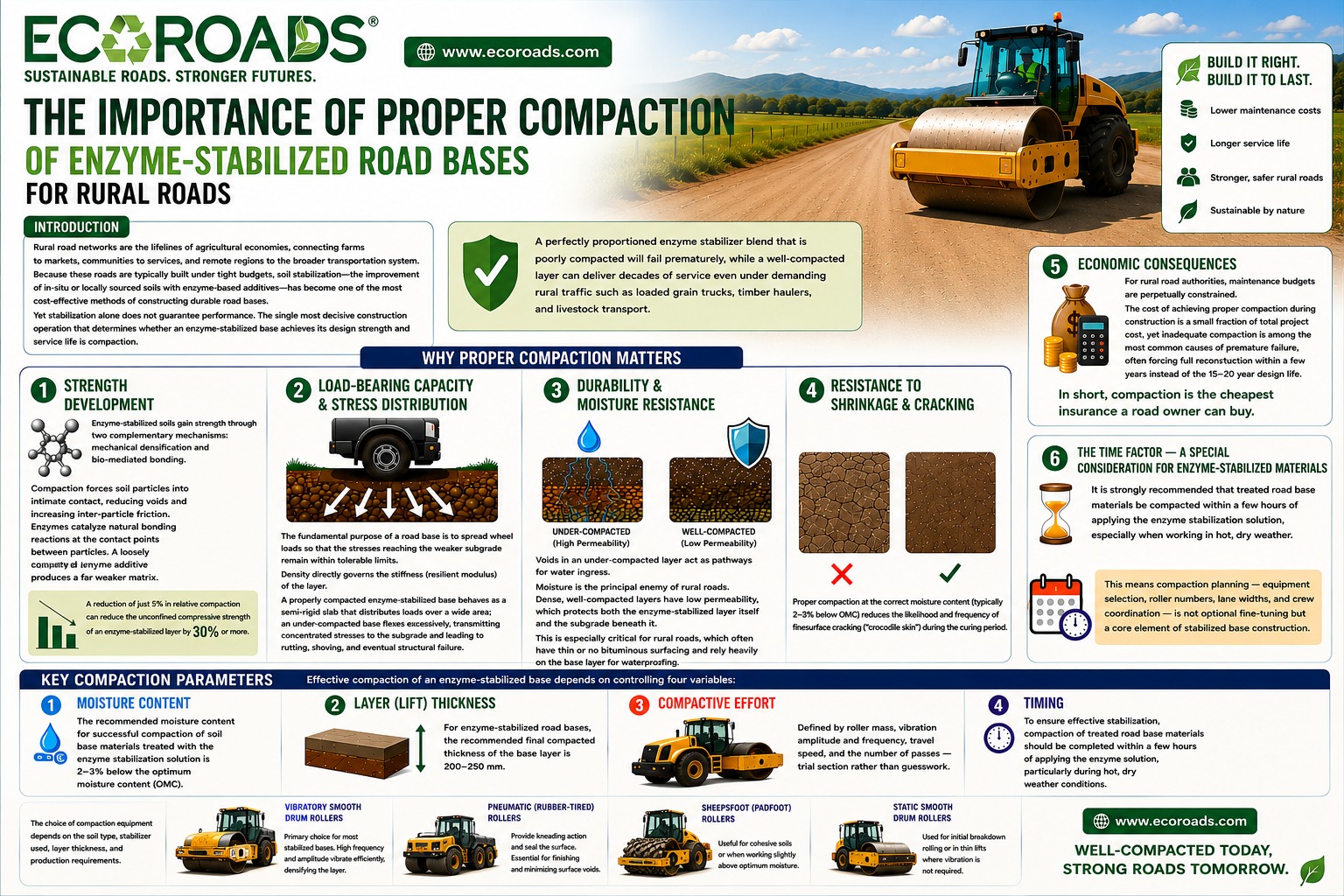
Introduction
Rural road networks are the lifelines of agricultural economies, connecting farms to markets, communities to services, and remote regions to the broader transportation system. Because these roads are typically built under tight budgets, soil stabilization — the improvement of in-situ or locally sourced soils with an additive — has become one of the most cost-effective methods of constructing durable road bases. While conventional binders such as cement, lime, and fly ash have long been used for this purpose, enzyme-based stabilization has gained rapid acceptance for rural roads because it works with the natural soil already on site rather than importing large volumes of aggregate or chemically rigid binder.
ECOROADS is a concentrated, natural based liquid enzyme stabilizer designed for exactly this application. Diluted in the compaction water and mixed into fine-grained soils, it catalysis reactions between the clay particles and soil moisture that permanently reduce the clay’s affinity for water, allowing the treated soil to be compacted into a far denser, more stable, and less permeable mass than the untreated material would ever reach. The result is a strong, water-resistant road base built largely from the soil the road is already made of.
Yet stabilization alone does not guarantee performance. Because ECOROADS works by enabling, not replacing, mechanical densification, the single most decisive construction operation that determines whether the stabilized base achieves its design strength and service life is compaction. The enzyme makes a tighter, more water-resistant packing of the clay possible; only the rollers make it real. A correctly dosed ECOROADS application that is poorly compacted will fail prematurely, while a well-compacted layer can deliver decades of service even under demanding rural traffic such as loaded grain trucks, timber haulers, and livestock transport. This article explains why proper compaction is so critical to capturing the full benefit of enzyme stabilization, and how to plan, execute, and control it.
The Benefits of ECOROADS® Enzyme Stabilization
ECOROADS offers a combination of structural, economic, and environmental advantages that make it especially well-suited to rural road construction. It is important to recognize from the outset that every one of these benefits is unlocked by — and conditional upon — achieving the specified field density. The enzyme creates the potential for a superior layer; compaction converts that potential into delivered performance.
- Uses in-situ and local soils. Fine-grained, clayey soils that would otherwise be rejected as base material can be treated in place, dramatically reducing the cost and carbon of hauling in imported gravel or crushed aggregate.
- Permanent reduction in water sensitivity. By neutralising the clay’s attraction to water, the treatment reduces swelling, shrinkage, and softening — the chief causes of rural-road failure — and produces a layer that stays stable through wet and dry seasons.
- Higher density and bearing capacity. With the adsorbed-water film broken down, the same compactive effort drives the soil to a higher dry density and a markedly higher CBR than the untreated material, yielding a stiffer, stronger base.
- Low permeability and effective waterproofing. A dense, enzyme-treated layer sheds water rather than absorbing it, protecting both the base and the subgrade beneath — critical for rural roads with thin or no bituminous surfacing.
- No brittle cementitious crust. Unlike cement- or lime-bound layers, an enzyme-stabilized base is essentially free of binder-induced shrinkage cracking; it remains a dense, tightly knit, slightly flexible platform.
- A forgiving, re-workable working window. With no hydration set to race, material that has not been finished can generally be re-moistened and re-worked, and defective areas can be scarified and re-compacted rather than demolished.
- Conventional plant, simple logistics. Standard recyclers/stabilizers, graders, water carts, and rollers do the work — no specialist equipment — while the highly concentrated liquid ships in small volumes, easing supply to remote sites.
- Environmentally benign. The enzyme is organic and non-toxic, and treating soil in place avoids the emissions of cement/lime manufacture and aggregate haulage, giving the technique a substantially lower carbon footprint.
- Faster construction and lower lifecycle cost. Low additive cost, reduced material movement, and a quick return to traffic after the layer dries back combine to lower both initial and whole-of-life costs.
Why Proper Compaction Matters
1. Strength Development
ECOROADS enzyme-based stabilized soils gain strength through two complementary mechanisms: mechanical densification and the enzyme-catalyzed modification of the clay–water system. ECOROADS accelerates cation exchange and breaks down the thick film of adsorbed water surrounding clay particles, so that under roller energy the particles slide into far closer contact than untreated soil would permit. Crucially, the enzyme does not “glue” the soil the way a cementitious binder does; it makes a higher density achievable — and the strength of the finished layer is realized only if that density is actually delivered by the rollers. A loosely compacted ECOROADS treated layer retains the voids and water-attracting behavior the treatment was meant to eliminate, so the same quantity of enzyme produces a far weaker, moisture-sensitive matrix. Field experience consistently shows that the bearing capacity and cohesion of an enzyme-treated layer rise steeply with relative compaction, and that a shortfall of just a few percent in density forfeits much of the strength gain the treatment can offer. (For comparison, even in conventional cement work a reduction of just 5% in relative compaction can cut unconfined compressive strength by 30% or more — density discipline is decisive for every stabilizer.)
2. Load-Bearing Capacity and Stress Distribution
The fundamental purpose of a road base is to spread wheel loads so that the stresses reaching the weaker subgrade remain within tolerable limits. Density directly governs the stiffness (resilient modulus) of the layer. A properly compacted enzyme-stabilized base behaves as a dense, tightly bound platform that distributes loads over a wide area; an under-compacted base flexes excessively, transmitting concentrated stresses to the subgrade and leading to rutting, shoving, and eventual structural failure.
3. Durability and Moisture Resistance
Voids in an under-compacted layer act as pathways for water ingress. Moisture is the principal enemy of rural roads: it softens the subgrade, swells untreated clay pockets, promotes freeze–thaw damage in cold climates, and erodes unbound fines. The central benefit of ECOROADS stabilization, a permanent reduction in the clay’s attraction to water, is only fully expressed in a dense matrix: low void content and the enzyme-modified clay together give the layer very low permeability and greatly reduced swell. This protects both the stabilized layer itself and the subgrade beneath it, which is especially critical for rural roads that often have thin or no bituminous surfacing and rely heavily on the base layer for waterproofing.
4. Resistance to Surface Loss and Cracking
Unlike cementitious binders, enzyme-stabilized layers are essentially free of binder-induced shrinkage cracking — one of the technique’s practical advantages. The cracking and raveling risks that do exist are moisture-driven: compacting too wet leaves excess water that must later evaporate, producing drying shrinkage and a weakly knitted surface, while compacting too dry prevents the enzyme-bearing water from being distributed through the clay fraction. Proper compaction at or near optimum moisture content minimizes both risks and produces a tight, well-knitted surface that resists raveling under direct traffic.
5. Economic Consequences
For rural road authorities, maintenance budgets are perpetually constrained. The cost of achieving proper compaction during construction is a small fraction of total project cost, yet inadequate compaction is among the most common causes of premature failure, often forcing full reconstruction within a few years instead of the 15–20 year design life. ECOROADS is attractive precisely because the additive cost is low and conventional earthmoving plant is used — but that economy is realised only when the compaction operation is taken seriously. In short, compaction is the cheapest insurance a road owner can buy.
6. The Time Factor — A Practical Advantage of Enzyme Treatment
One of the operational advantages of ECOROADS is its forgiving working window. Because there is no hydration set, the mixed material does not “go off” within a couple of hours the way a cement-treated base does, and material that has not been finished can generally be re-moistened and re-worked without permanent damage. The time pressure that does exist is moisture-driven: the enzyme is delivered in the compaction water, so the layer must be compacted while the moisture content is still near optimum. In hot, windy rural conditions, evaporation can pull the surface below the workable range within hours, forcing re-watering and re-mixing that wastes time and risks uneven enzyme distribution. Compaction planning — equipment selection, roller numbers, lane widths, water-cart cycles, and crew coordination — therefore remains a core element of enzyme-stabilized base construction, not optional fine-tuning.
Key Compaction Parameters
Effective compaction of an stabilized base depends on controlling four variables:
- Moisture content. Every soil–enzyme mixture has an optimum moisture content (OMC) at which a given compactive effort produces maximum dry density (MDD). Field moisture should normally be held within ±1–2% of OMC — and because the diluted enzyme is applied in the compaction water, moisture control is simultaneously dosage control. Hot, windy rural conditions cause rapid evaporation and must be compensated by the water cart.
- Layer (lift) thickness. Compacted lifts are typically limited to 150–200 mm (up to 250–300 mm with heavy vibratory equipment and verification trials), because compactive energy decays with depth and a thick lift will show a dense crust over a weak bottom.
- Compactive effort. Defined by roller mass, vibration amplitude and frequency, travel speed, and the number of passes — best established through a field trial section rather than guesswork.
- Timing. All compaction should be completed while the layer is within the specified moisture band, and the finished surface should then be shaped tight and allowed to air-cure (dry back) before being opened to traffic.
Types of Compactors Suitable for Stabilized Road Bases
The choice of compaction equipment depends on the soil type, layer thickness, and project scale. Because enzyme stabilization is most effective in fine-grained soils with an appreciable clay fraction, kneading-type compactors play an especially prominent role. On rural projects, a combination of machines is usually employed in a compaction “train.”
1. Vibratory Smooth Drum Rollers
The workhorse of stabilized base compaction. Single-drum vibratory rollers in the 12–20 tone class combine static weight with dynamic vibratory energy, rearranging particles and achieving high densities through the full lift, particularly in sandy and gravelly soils whose fines fraction carries the enzyme treatment. Modern machines allow variable amplitude and frequency: high amplitude/low frequency for initial deep compaction of thicker lifts, low amplitude/high frequency for finishing. Operating speed should generally be kept between 3 and 6 km/h. Because enzyme-treated material has no chemical set, vibratory passes can be sequenced flexibly across the shift — the governing constraint is keeping the layer within the moisture band, not racing a binder’s setting time.
2. Padfoot (Tamping-Foot) and Sheepsfoot Rollers
Essential for fine-grained, cohesive soils — exactly the clays and silty clays for which enzyme stabilization is best suited on rural roads. The projecting pads penetrate the loose lift and compact it from the bottom up, kneading the soil, breaking down clods, and working the enzyme-bearing water uniformly through the clay fraction — the kneading action itself improves contact between the enzyme solution and the clay particles it must modify. The roller “walks out” of the layer as density increases, which is a useful visual indicator of progress. Vibratory padfoot rollers combine kneading with dynamic energy and are highly productive on enzyme-treated clays. Because padfoot rollers leave an indented surface, they are always followed by a smooth drum or pneumatic roller to seal and finish the layer.
3. Pneumatic-Tyre Rollers (PTR)
Multi-wheel rubber-tyre rollers (typically 10–25 tones) apply a kneading action that manipulates the material, closes surface voids, and produces a tight, sealed finish. They are particularly valuable as finishing rollers on enzyme-treated bases, where the kneading action knits the fines into a dense, water-shedding skin, and for proof-rolling. Tyre pressure can be adjusted to suit the material, higher pressures for greater depth of influence, lower pressures for surface sealing. On rural roads the PTR’s sealing action is doubly important because the enzyme-stabilized base may carry traffic directly or receive only a thin chip seal.
4. Static Three-Wheel and Tandem Steel Rollers
Traditional static steel rollers (8–12 tons) are less efficient at deep densification than vibratory machines, but remain useful for final finishing passes, removing roller marks, tightening the surface after the layer has begun to dry back, and compacting near structures where vibration is undesirable.
5. Grid Rollers
Towed grid rollers are occasionally used in rural settings on coarse, gravelly, or soft-rock materials, where the grid breaks down oversize particles while compacting. Their role in enzyme-stabilized work is mainly in pre-processing marginal materials, reducing oversize and generating fines, before the enzyme treatment is applied.
6. Impact (High-Energy) Rollers
Non-circular (3-, 4-, or 5-sided) towed impact rollers deliver very high energy per blow and can compact thick lifts or improve subgrades in deep layers. They are more common in subgrade improvement than in finished stabilized base work, but on large rural programs they can reduce the number of lifts required.
7. Small Equipment for Confined Areas
Rural projects inevitably include culvert crossings, bridge approaches, widenings, and utility trenches where large rollers cannot operate. Walk-behind vibratory rollers, trench rollers, plate compactors, and rammers (jumping jacks) must be used, with lift thicknesses reduced (often to 100–150 mm) to compensate for their lower energy. These confined areas are notorious weak points and deserve extra testing attention.
Typical Compaction Train for a Rural Enzyme-Stabilized Base
A common and effective sequence is: padfoot vibratory roller for initial breakdown compaction and kneading of the cohesive, enzyme-treated soil → heavy smooth drum vibratory roller for primary densification → pneumatic-tyred roller for kneading and sealing → static smooth drum for final finish, with a grader trimming the surface between intermediate and final rolling.
Compaction Control: What Must Be Implemented
Compaction quality cannot be left to visual judgment. A structured quality control / quality assurance (QC/QA) system must be implemented, comprising laboratory reference testing, a field trial, in-process control, and acceptance testing.
1. Laboratory Reference Testing (Before Construction)
The control program begins in the laboratory. For each soil–enzyme combination, a moisture–density relationship must be established using the Proctor compaction test — standard Proctor (AASHTO T 99 / ASTM D698) or, more commonly for road bases, modified Proctor (AASHTO T 180 / ASTM D1557) — with ECOROADS® included in the compaction water at the design dilution. This defines the maximum dry density (MDD) and optimum moisture content (OMC) that become the reference for all field control. Equally important is confirming that the soil is suitable for enzyme treatment at all: Atterberg limits and gradation should verify an adequate clay/fines content and plasticity (enzymes are ineffective in clean, non-plastic sands and gravels), and organic content should be checked where peaty or topsoil contamination is suspected. Supporting strength tests — California Bearing Ratio (CBR) and/or unconfined compressive strength (UCS) on treated versus untreated specimens — should be carried out at the design application rate, with treated specimens cured (air-dried) for the period specified in the ECOROADS® technical documentation before testing, because enzyme-treated soils gain strength gradually as they dry and consolidate rather than through a rapid chemical set.
2. Field Trial Section
Before full production, a trial section (typically 100–200 m) recommended to be constructed using the proposed equipment, lift thickness, moisture targets, and enzyme dilution. Density is measured after successive roller passes to develop a compaction growth curve, establishing the rolling pattern (machine type, amplitude, speed, number of passes) that reliably achieves the specified density while the layer remains within the moisture band. The approved pattern then becomes a method-control element of the specification — invaluable on rural projects where testing resources are limited.
3. In-Process (Method and Moisture) Control
During production, continuous checks must include: the enzyme application rate (verifying the volume of ECOROADS concentrate metered into each water-cart load against the design rate — typically expressed as liters of concentrate per cubic meter of compacted soil, and logging every load); dilution and distribution uniformity (consistent spray-bar output and overlapping watering passes); mixing depth and uniformity (test holes behind the recycler or grader to confirm full-depth, streak-free blending); field moisture content immediately before compaction (oven drying, speedy moisture tester, or calibrated moisture probes); and lift thickness (depth checks behind the recycler/grader). Ambient conditions (temperature, wind, rain risk) should be logged because they govern evaporation and the time available to complete compaction within the moisture band.
4. Field Density (Acceptance) Testing
The core acceptance criterion is relative compaction — field dry density expressed as a percentage of laboratory MDD. Typical specifications for enzyme-stabilized rural road bases require 95–98% of modified Proctor MDD (or 98–100% of standard Proctor, depending on the governing standard), with moisture within the specified band. The principal test methods are:
- Nuclear density gauge (ASTM D6938 / AASHTO T 310): the fastest and most widely used method, giving wet density and moisture in 1–4 minutes per test. It allows high testing frequency and immediate corrective action. Gauges must be calibrated against the project material (moisture readings in particular should be verified against oven drying on clayey soils) and operated under radiation-safety licensing.
- Sand cone test (ASTM D1556) and rubber balloon test (ASTM D2167): classical direct-measurement methods, slower but independent of calibration assumptions, often used to verify nuclear gauge results or where gauges are unavailable — a common situation on remote rural projects.
- Non-nuclear electrical gauges (e.g., ASTM D7830): increasingly used to avoid radiological licensing, but they require careful material-specific calibration, particularly on treated clayey soils.
Testing frequency should be specified — commonly one density test per 250–500 m² of layer, or per 100–200 linear meters per lane, with additional tests at culverts, approaches, joints between work sections, and any area of doubt. A statistical acceptance scheme (lot-based, with minimum individual and mean values) gives better protection than isolated spot tests.
5. Strength and Stiffness Verification
Density alone does not prove the enzyme treatment is working; complementary controls should include: CBR or UCS testing of field-mixed material compacted into moulds on site and cured (air-dried) for the specified period, checked against the design strength; the Dynamic Cone Penetrometer (DCP, ASTM D6951), an inexpensive, robust tool ideally suited to rural projects for verifying uniformity with depth and detecting weak lower zones in the lift — and, repeated after the curing period, for confirming the strength gain of the enzyme-treated layer as it dries; and the Light Weight Deflectometer (LWD, ASTM E2583) or Falling Weight Deflectometer for modulus-based verification where deflection-based specifications are used.
6. Proof Rolling
Before surfacing, the completed base should be proof-rolled with a loaded truck (e.g., 8-tonne axle) or heavy pneumatic roller under observation. Any visible deflection, pumping, or rutting identifies soft spots that density tests on a grid may have missed. Defective areas must be reworked — and here enzyme stabilization holds a clear practical advantage: unlike a cemented layer past its setting time, a defective enzyme-treated area can usually be scarified, re-moistened (with enzyme-dosed water if additional mixing is needed), and re-compacted rather than removed and replaced.
7. Intelligent Compaction (IC) and Continuous Compaction Control (CCC)
Modern rollers can be fitted with drum-mounted accelerometers, GPS mapping, and onboard displays that record stiffness-related values (CMV, MDP, Evib) over 100% of the layer, rather than the <1% coverage of spot testing. For rural agencies managing long, linear projects with few technicians, IC offers full-coverage documentation of pass counts and uniformity, flagging weak areas for targeted spot testing. IC values must always be correlated to conventional density/modulus tests on a calibration strip, but as a process-control tool it dramatically improves uniformity — and uniformity is itself a major determinant of pavement life.
8. Curing Control
Compaction control does not end when the roller leaves. Enzyme-stabilized layers cure by drying back and consolidating: the finished surface should be shaped tight, drained, and protected from heavy traffic and rain for typically 24–72 hours (longer in cool or humid weather), allowing the layer to dry toward its stable in-service moisture content. Unlike cementitious layers, no moist curing or curing membrane is required — drying is precisely what develops the strength — but premature trafficking of a still-wet layer, or saturation by rain before the surface has tightened, will damage the work. Records of curing duration, weather, and the date the layer was opened to traffic or sealed form part of the quality file.
9. Documentation
Every lot should be traceable through records of: ECOROADS® batch numbers, dilution rates and water-cart loads, mixing depth, moisture tests, rolling pattern and pass counts, density and strength test results, proof-rolling observations, and curing. On rural programs delivered by small contractors, a simple standardized lot sheet enforces discipline and provides the evidence base for acceptance and future maintenance planning.
Common Compaction Defects and Their Causes
Several recurring problems deserve mention. Low density at the bottom of the lift usually indicates an excessive lift thickness or insufficient roller energy, and is best detected with the DCP. A loose, dusty, or ravelling surface results from compacting after the surface has dried below the workable moisture range, or from finishing without adequate kneading by a pneumatic roller; the remedy is light moisture fogging (with plain water) and re-rolling before the layer dries out. Laminations occur when a thin re-trimmed layer is compacted over an already dried-back surface without scarifying and re-moistening it to achieve bond. Soft, rutting areas after opening to traffic typically indicate compaction at excessive moisture, an under-dosed or poorly mixed enzyme application, or trafficking before the layer had dried back and gained strength. Each of these defects is preventable through the control regime described above.
Conclusion
For rural roads, where stabilized bases often serve as the principal, sometimes the only, structural and waterproofing layer, proper compaction is not a routine construction detail but the decisive factor between a road that lasts two decades and one that fails in two years. This is doubly true for ECOROADS enzyme stabilization, whose entire mechanism depends on densification: the enzyme makes a tighter, more water-resistant packing of the clay possible, and only the rollers make it real. The structural, economic, and environmental benefits of treating soil in place — higher density and bearing capacity, low permeability, freedom from shrinkage cracking, a forgiving working window, and low cost and low carbon footprint, are all delivered through, and conditional upon, the density achieved in the field.
Capturing those benefits requires three things working together: a clear understanding of why density matters for strength, stiffness, durability, and moisture resistance; the right combination of compaction equipment — padfoot rollers for kneading the cohesive, enzyme-treated soil, heavy vibratory smooth drums for primary densification, and pneumatic-tyre rollers for kneading and sealing — operated within the layer’s workable moisture band; and a rigorous but practical control system built on Proctor reference values established with ECOROADS-dosed water, soil suitability and dosage verification, trial sections, field density testing (nuclear gauge, sand cone, or non-nuclear methods), DCP and CBR/UCS verification before and after curing, proof rolling, dry-back curing control, and complete documentation. Agencies and contractors that institutionalize these practices convert the inherent economy of ECOROADS enzyme soil stabilization into genuinely long-lived rural infrastructure, protecting scarce maintenance budgets and the communities that depend on these roads.
Note: Specification values cited (relative compaction targets, lift thicknesses, curing periods, testing frequencies) are typical international practice. ECOROADS dilution rates, soil suitability criteria, application rates, and curing requirements should always be confirmed against the ECOROADS technical documentation, together with the governing national or agency standard for your project or local rural road specifications.
The post The Importance of Proper Compaction in Soil Stabilization of Rural Road Bases appeared first on TERRAROADS EQUIPMENT | EQUIPMENT FOR ROAD CONSTRUCTION AND MAINTENANCE.
]]>The post Roads That Build Communities The Social Benefits of ECOROADS® Soil Stabilization for Rural Populations appeared first on TERRAROADS EQUIPMENT | EQUIPMENT FOR ROAD CONSTRUCTION AND MAINTENANCE.
]]>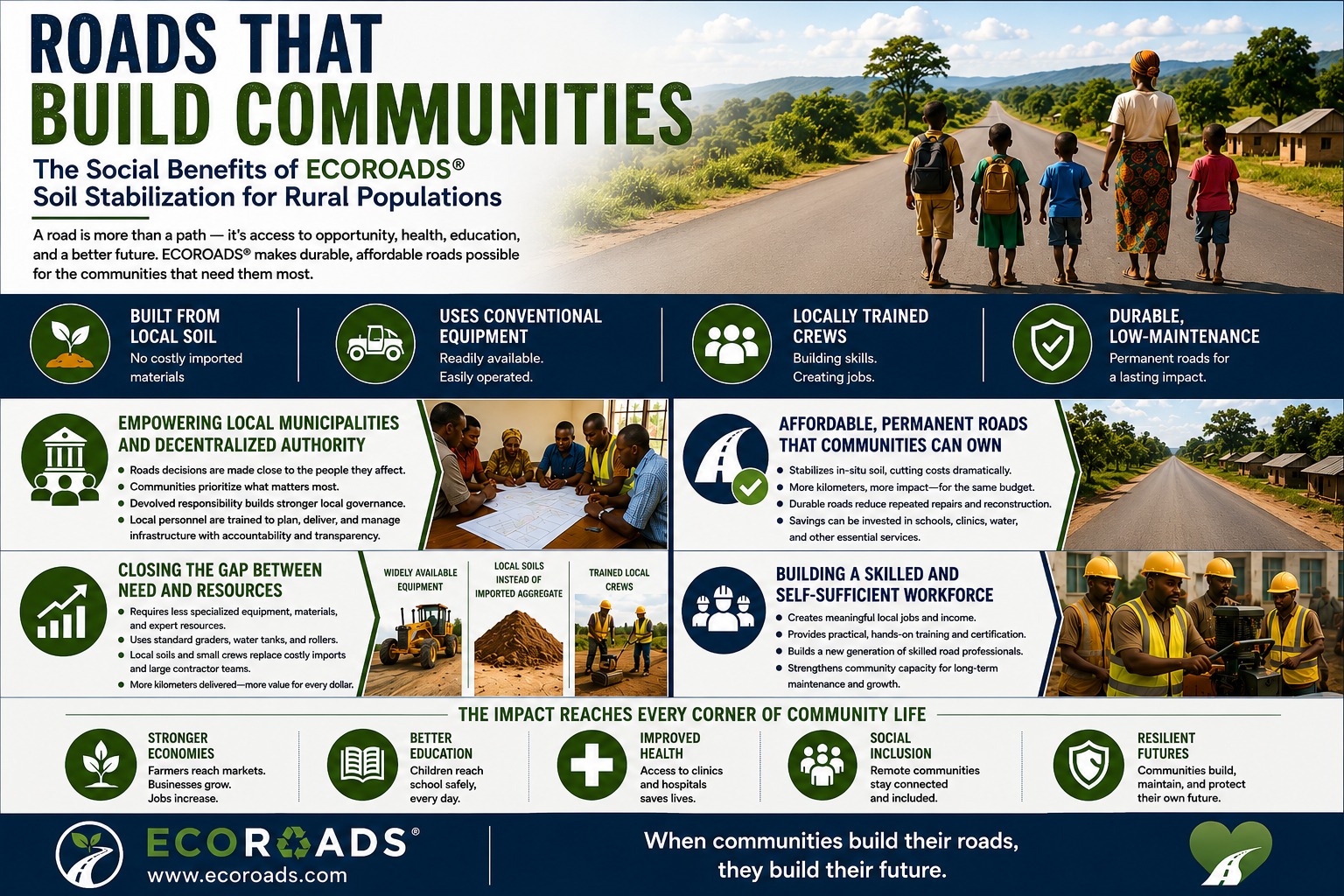
Introduction
A rural road is never only a road. For the communities it serves, it is the difference between a harvest that reaches the market and one that rots in the field; between a child who reaches school every day and one who is kept home when the track turns to mud; between a clinic an expectant mother can reach in time and one that lies beyond the reach of an emergency. Across much of the rural and developing world, the absence of reliable, all-weather roads remains one of the most persistent barriers to economic opportunity, public health, and social inclusion. Yet conventional road construction — dependent on imported aggregate, heavy specialist plant, costly bitumen or concrete, and contractors brought in from distant cities — is frequently beyond the financial and logistical reach of the very municipalities that need roads most.
ECOROADS was developed to change that equation. As a state-of-the-art, enzyme-based soil stabilization solution, it allows durable, low-cost roads to be built largely from the soil already present along the alignment, using conventional earthmoving equipment and locally trained crews. But the value of ECOROADS extends well beyond engineering economy. By placing the construction, renovation, and maintenance of roads within the practical and financial reach of local communities, it becomes an instrument of social development — a means to devolve responsibility to local authorities, create lasting employment, train a new generation of skilled workers, open access to markets and services, and build a genuine sense of ownership and pride in the infrastructure that communities depend on. The pages that follow set out those social benefits in detail.
Empowering Local Municipalities and Decentralized Authority
A central objective of the ECOROADS approach is to enable local and rural road and infrastructure projects to be implemented directly by local municipalities and decentralized territorial authorities, as part of a deliberate devolution of responsibility from the central State. When the power and the practical means to build and maintain roads are placed in local hands, decisions are made closer to the people they affect. Communities themselves can prioritize which roads matter most — the link to the grain silo, the route to the district hospital, the crossing that floods every wet season — rather than waiting for those choices to be made in a distant capital.
This decentralization is only meaningful if it is matched by capability. The ECOROADS model therefore pairs devolved responsibility with the concurrent development of qualified local personnel, so that authorities are not handed a mandate they have no means to fulfil. Local technicians, supervisors, and administrators are trained alongside the works themselves, building the institutional muscle that allows a municipality to plan, procure, deliver, and account for its own infrastructure. Over time this strengthens local governance well beyond roads: it creates accountable institutions, transparent budgets, and a track record of delivery that communities can see and trust.
Affordable, Permanent Roads That Communities Can Own
ECOROADS is a sustainable and permanent solution for low-cost, affordable roads. Affordability is not a secondary virtue here — it is the very thing that makes local ownership possible. Because the technology stabilizes the in-situ soil rather than relying on expensive imported materials and binders, the cost per kilometer falls dramatically, and a municipal budget that once stretched to a few kilometers of conventional road can now cover many times that distance. Roads that were previously unaffordable become achievable; networks that were previously aspirational become real.
Permanence compounds the benefit. A road that lasts, and that local crews can repair when it does not, breaks the destructive cycle in which scarce funds are spent building roads that wash away within a season or two. Money that would have gone to repeated reconstruction can instead be invested in extending the network, in schools, in clinics, in water. For communities living on tight and uncertain budgets, a durable, low-maintenance road is not merely an asset; it is a source of financial stability and a foundation for longer-term planning.
Closing the Gap Between Need and Resources
Almost every rural authority faces the same arithmetic problem: the number of kilometers of road that the population needs vastly exceeds the civil-engineering resources available to deliver them. There are too few qualified engineers, too little heavy equipment, too small a budget, and too short a working season. Conventional methods widen this gap, because they demand precisely the scarce, expensive, specialist resources that rural areas lack.
ECOROADS is designed to close it. By lowering the threshold of equipment, materials, and specialist expertise required to build a permanent road, the technology lets municipalities do far more with the resources they actually have. Standard road graders, water tanks, and rollers — machines that are widely available or readily hired, replace fleets of special and sophisticated equipment. Local soils replace quarried aggregate. Trained local small crews replace extensive team of contractors. The result is more kilometers delivered per unit of money, equipment, and time, and a realistic path to closing the chronic shortfall between what communities need and what they have historically been able to build.
Building a Skilled and Self-Sufficient Local Workforce
Perhaps the most enduring social benefit of the ECOROADS approach is the creation of opportunity for thoughtful training of the local countryside workforce. The local labor force gains the opportunity to acquire lasting technical knowledge and hands-on experience in road construction and maintenance. Through training and participation in project activities, workers learn safe equipment operation, fundamental civil engineering concepts, and the practical skills required to construct, rehabilitate, and maintain their own local road infrastructure. This capacity-building approach strengthens local expertise, promotes long-term self-sufficiency, and ensures that communities can effectively maintain and improve their road networks for years to come.
Skills, once acquired, stay in the community. A locally trained workforce can respond to damage quickly, carry out routine maintenance before small defects become expensive failures, and take on the next project without waiting for outside contractors to become available. This self-sufficiency transforms the relationship between a community and its infrastructure: the road is no longer something done to the community by outsiders, but something the community knows how to build and keep. The same skills are transferable to other construction and infrastructure work, raising local earning power and creating a pool of capable tradespeople where none existed before.
Opportunity and Inclusion for Young People
Rural areas across the world share a common challenge: too few opportunities for their young people, who too often must choose between unemployment at home and migration to overcrowded cities. Implementation of ECOROADS solution is built to offer a different path. It provides methodological support for the planning and implementation of local community development aimed squarely at young people, giving them structured, practical pathways into meaningful work and lifelong skills.
Crucially, this opportunity welcomes young people from all backgrounds, regardless of their education level, social status, or previous work experience. It provides a pathway for those who are often excluded from formal employment due to limited qualifications or opportunities, enabling them to develop practical skills, gain valuable work experience, and earn a sustainable income. By creating meaningful local employment, it helps reduce rural out-migration, retains talent and ambition within the community, and empowers a new generation to become the builders, maintainers, and stewards of their own infrastructure and future development.
Jobs, Mobility, and Access to Markets
By bringing new technology to meet today’s growing demand for safe, sustainable roads, the ECOROADS approach creates jobs for local labor at every stage — survey and preparation, mixing and stabilization, compaction and finishing, and the ongoing maintenance that follows. These are not transient jobs that vanish when an outside contractor leaves; because the workforce is local and the skills remain, employment is sustained across the life of the network.
Beyond the direct jobs, good roads unlock the wider rural economy. They facilitate free movement to and from markets, allowing farmers to sell their produce before it spoils, to reach more buyers, and to command fairer prices instead of accepting whatever a single intermediary will offer. Lower transport costs leave more income in local hands. Reliable, all-weather access encourages traders, services, and small enterprises to operate where impassable roads once made business impossible. Safe transport reduces the accidents and breakdowns that plague rough tracks, and it shortens journeys that once consumed whole days, time that families can return to farming, schooling, and earning. In this way a single road radiates economic benefit far beyond its own surface.
Health, Education, and Everyday Quality of Life
The human benefits of dependable rural roads are profound and immediate. An all-weather road means a sick child or an expectant mother can reach a clinic when minutes matter, and that medicines, vaccines, and health workers can reach the village in return. It means children can attend school consistently rather than missing weeks each rainy season, and that teachers are willing to be posted to communities they can actually reach. It means the elderly and people with disabilities are no longer isolated by terrain. Each of these is a quality-of-life gain that compounds over a lifetime, and each becomes possible the moment a community gains a road it can rely on in every season — and keep in good repair through its own efforts.
Environmental Responsibility
Economic and social progress do not have to come at an environmental cost. ECOROADS is an environmentally responsible and innovative soil stabilization technology. It is bio-based, non-toxic, non-corrosive, non-combustible, and biodegradable. Because the technology stabilizes existing on-site soils, it significantly reduces the need for quarrying, crushing, and long-distance transportation of aggregates required by conventional road construction methods. As a result, it helps lower greenhouse gas emissions, reduce dust generation, and minimize the environmental impacts associated with material extraction and transport. Roads stabilized with ECOROADS are also more resistant to moisture, erosion, and extreme weather conditions, making them better suited to withstand the challenges of a changing climate. For rural populations whose livelihoods are closely tied to the land and natural environment, sustainable infrastructure is not merely an environmental objective – it is essential to both present and future well-being.
National Pride and Social Cohesion
When a community builds its own road, with its own people, its own hands, and its own soil, something changes that no contractor delivering a finished product from outside could ever provide. The road becomes a shared achievement. The workers who built it, the young people who learned their trade on it, and the families who travel it daily all share in a visible, lasting symbol of what their community can accomplish. This instils a strong sense of national pride and local identity, and it knits communities more tightly together around a common purpose. Pride of ownership also protects the investment: people care for what they have built themselves, and a road the community is proud of is a road the community will maintain.
Conclusion
The case for ECOROADS implementation rests on far more than the cost-effective and sustainable construction, maintenance, and rehabilitation of roads—although it delivers all of these benefits. Its deeper promise is social.
By empowering local municipalities to take greater responsibility for their road networks and by developing the capacity of local people to manage and maintain them, ECOROADS makes durable, high-quality roads affordable and accessible to the communities that depend on them. It helps bridge the long-standing gap between rural needs and available resources by training a skilled local workforce, creating employment opportunities, and opening doors to young people from all backgrounds. In doing so, it enables communities to develop the knowledge, skills, and self-reliance needed to sustain their infrastructure for the long term.
At the same time, improved roads provide reliable access to markets, healthcare, education, and other essential services, supporting economic growth and improving quality of life. Delivered through an environmentally responsible approach that minimizes resource consumption and environmental impact, ECOROADS transforms road construction into a catalyst for community development.
By meeting the growing demand for safe, sustainable, and affordable road infrastructure—and the mobility and connectivity it enables—ECOROADS offers rural populations not only better roads, but also greater opportunity, resilience, dignity, and pride in the future they are building for themselves.
The post Roads That Build Communities The Social Benefits of ECOROADS® Soil Stabilization for Rural Populations appeared first on TERRAROADS EQUIPMENT | EQUIPMENT FOR ROAD CONSTRUCTION AND MAINTENANCE.
]]>The post Road Maintenance Cost Reduction: Engineering Strategies That Work appeared first on TERRAROADS EQUIPMENT | EQUIPMENT FOR ROAD CONSTRUCTION AND MAINTENANCE.
]]>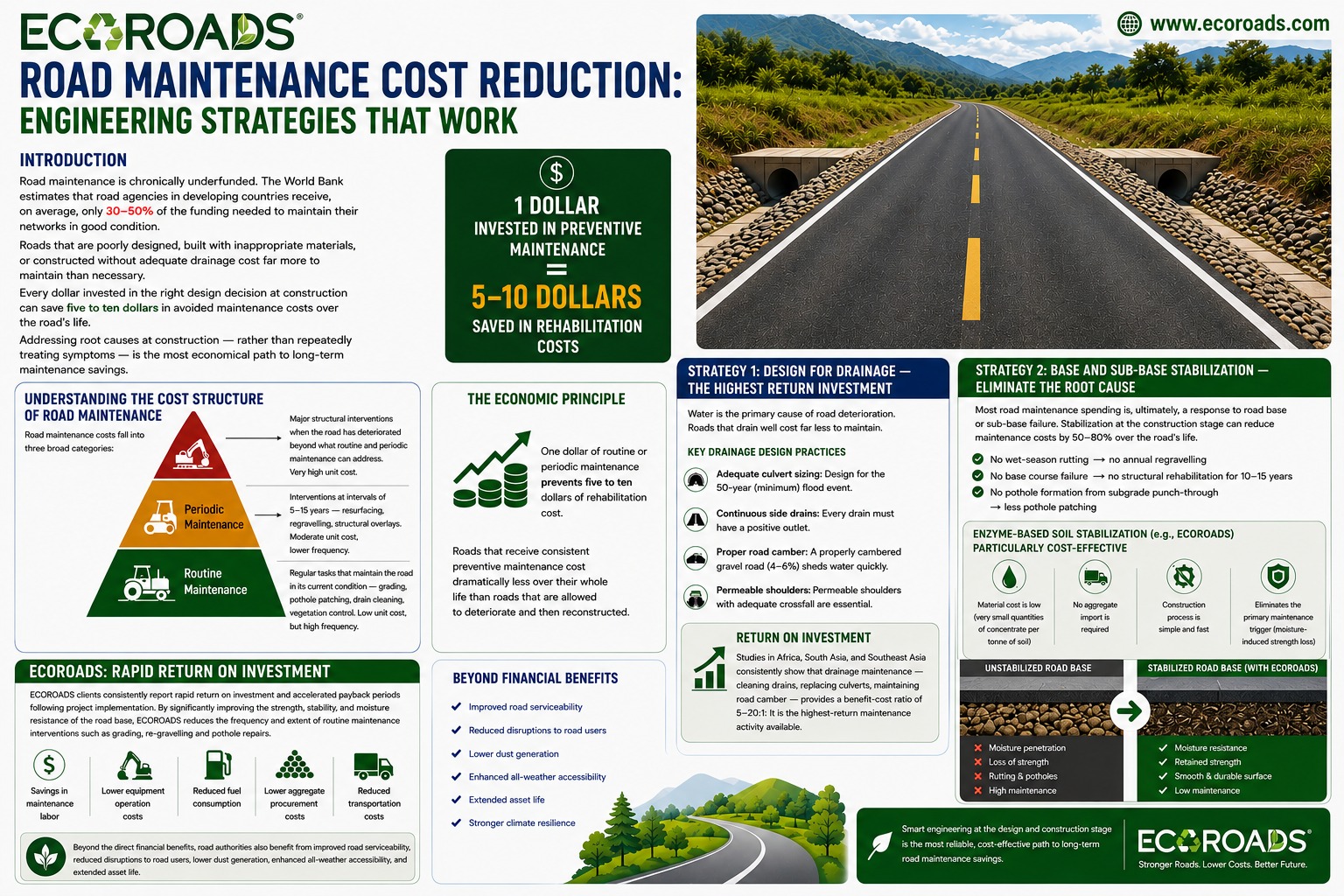
Introduction
Road maintenance is chronically underfunded in most countries. The World Bank estimates that road agencies in developing countries receive, on average, only 30–50% of the funding needed to maintain their networks in good condition. The consequence is well-documented: roads deteriorate faster than they are maintained, rehabilitation backlogs grow, and the eventual reconstruction cost far exceeds what regular maintenance would have cost.
But road maintenance cost reduction is not simply a funding problem. It is also an engineering problem. Many roads cost far more to maintain than necessary because they were poorly designed, built with inappropriate materials, or constructed without adequate drainage. Every dollar invested in the right design decision at the construction stage can save five to ten dollars in avoided maintenance costs over the road’s life. Proven solutions such as the ECOROADS enzyme-based soil stabilization system demonstrate that addressing root causes at construction — rather than repeatedly treating symptoms — is the most economical path to long-term maintenance savings.
This article explores the most impactful strategies for reducing road maintenance costs — covering design, construction, and operations — with particular attention to the interventions that deliver the greatest return on investment.
Understanding the Cost Structure of Road Maintenance
Road maintenance costs fall into three broad categories:
- Routine maintenance: Regular tasks that maintain the road in its current condition — grading, pothole patching, drain cleaning, vegetation control. Low unit cost, but high frequency.
- Periodic maintenance: Interventions at intervals of 5–15 years — resurfacing, regravelling, structural overlays. Moderate unit cost, lower frequency.
- Rehabilitation and reconstruction: Major structural interventions when the road has deteriorated beyond what routine and periodic maintenance can address. Very high unit cost.
The fundamental economic principle of road maintenance is that one dollar of routine or periodic maintenance prevents five to ten dollars of rehabilitation cost. Roads that receive consistent preventive maintenance cost dramatically less over their whole life than roads that are allowed to deteriorate and then reconstructed.
Strategy 1: Design for Drainage — The Highest Return Investment
The single most cost-effective maintenance reduction strategy is adequate drainage design at the construction stage. Water is the primary cause of road deterioration. Roads that drain well cost less to maintain than roads that don’t — by a wide margin.
Key drainage design practices that reduce lifetime maintenance costs:
- Adequate culvert sizing: Undersized culverts overtop during major rainfall events, washing out embankments and pavements. The cost of one washout event typically exceeds the cost of upsizing the culvert by a factor of 10–50. Design for the 50-year (minimum) flood event.
- Continuous side drains: Side drains that do not connect to natural drainage outlets allow water to pond, infiltrate the formation, and soften the subgrade. Every drain must have a positive outlet.
- Adequate road camber: A properly cambered gravel road (4–6%) sheds water to the shoulders quickly. A flat or rutted road retains water in the wheel tracks, accelerating pothole formation and subgrade softening.
- Shoulder drainage: Sealed roads with sealed or unpermeable shoulders prevent edge drainage, trapping water in the base layers. Permeable shoulders with adequate crossfall are essential.
- Return on investment: Studies in Africa, South Asia, and Southeast Asia consistently show that drainage maintenance — cleaning drains, replacing culverts, maintaining road camber — provides a benefit-cost ratio of 5–20:1. It is the highest-return maintenance activity available.
Strategy 2: Base and Sub-Base Stabilization — Eliminate the Root Cause
Most road maintenance spending is, ultimately, a response to road base or sub-base failure. A weak, moisture-sensitive road base, loses strength seasonally, allowing the pavement to deform under traffic. The deformed pavement admits more water, accelerating further deterioration in a vicious cycle.
Breaking this cycle by stabilizing the road base and sub-base at the construction stage can reduce maintenance costs by 50–80% over the road’s life:
- No wet-season rutting → no annual regravelling
- No base course failure → no structural rehabilitation for 10–15 years
- No pothole formation from subgrade punch-through → less pothole patching
Enzyme-based soil stabilization — such as the ECOROADS stabilization solution — is particularly cost-effective for subgrade treatment because:
- Material cost is low (very small quantities of concentrate per tonne of soil)
- No aggregate import is required
- Construction process is simple and fast
- The treatment eliminates the primary maintenance trigger (moisture-induced strength loss)
ECOROADS clients consistently report rapid return on investment and accelerated payback periods following project implementation. By significantly improving the strength, stability, and moisture resistance of the road base, ECOROADS reduces the frequency and extent of routine maintenance interventions such as grading, re-graveling and pothole repairs. In many cases, the initial stabilization investment is recovered within a relatively short period through savings in maintenance labor, equipment operation, fuel consumption, aggregate procurement, and transportation costs.
Beyond the direct financial benefits, road authorities also benefit from improved road serviceability, reduced disruptions to road users, lower dust generation, enhanced all-weather accessibility, and extended asset life. These cumulative advantages make ECOROADS a highly cost-effective solution for municipalities, rural road agencies, mining operations, agricultural developments, and other organizations seeking to reduce life-cycle road infrastructure costs while improving long-term performance.
Strategy 3: Pavement Performance Management
- Establish a baseline: You cannot manage what you do not measure. Road agencies that track pavement condition systematically using simple visual surveys, roughness measurements (IRI), or DCP/deflection testing, can identify deterioration early, when intervention is still cheap.
- Prioritize early intervention: Pavement condition deteriorates slowly at first, then rapidly (the “S-curve” of road deterioration). Intervening when the road is at 70–80% of good condition is far cheaper than waiting until it has collapsed to 20–30%. A crack seal or light overlay applied at the right time costs $2–5 per m² compared to $30–60 per m² for structural rehabilitation.
- Segment-based planning: Maintain road segments that are genuinely worth maintaining. For roads that are structurally sound but have surface defects, preventive maintenance is appropriate. For roads with structural failure, throwing maintenance money at surface treatments is wasteful, the underlying problem must be addressed first. In many cases, this means treating the failed road base: a one-time ECOROADS stabilization treatment can restore structural integrity and halt the deterioration cycle, making subsequent surface maintenance effective again.
Strategy 4: Material Selection and Quality Control
The use of poor-quality road construction materials is one of the primary causes of premature deterioration of rural roads. Weak, poorly graded, or moisture-sensitive materials often lack the structural strength required to withstand traffic loads and environmental conditions, leading to rutting, erosion, potholes, and surface deformation. As a result, road authorities are forced to undertake more frequent maintenance and rehabilitation activities, significantly increasing life-cycle costs. Ensuring the use of stable, durable, and properly engineered materials is therefore essential for achieving long-lasting road performance and minimizing ongoing maintenance expenditures.
- Enforce material specifications: Test aggregate at the source quarry, not just on arrival at site. Ensure the contractor is not blending off-specification material to meet aggregate supply schedules.
- Upgrade marginal materials: Where better aggregate is unavailable or too expensive, stabilizing marginal laterite with enzyme treatment can bring it to specification — at lower cost than sourcing premium material from a distance. ECOROADS soil stabilization is specifically designed for this application: it can elevate marginal, locally available soils to meet base course and sub-base bearing requirements without aggregate import, significantly reducing both construction cost and long-term maintenance expenditure.
- Use locally appropriate specifications: Material specifications developed for high-volume roads in temperate climates may be too conservative for low-volume roads in tropical contexts. Using inappropriately tight specifications drives up cost unnecessarily; using inappropriately loose specifications increases maintenance cost. Specifications should be calibrated to the local environment and traffic conditions.
Strategy 5: Whole-Life Cost Analysis
Decisions about road design, material selection, and rehabilitation strategy should be made on a whole-life cost basis — not just upfront construction cost.
Life-cycle cost, rather than initial construction cost, is the true measure of road infrastructure value. Proper stabilization treatment that adds a modest cost per kilometer during construction but reduces annual maintenance costs by tens of thousands of dollars per kilometer offers an exceptional return on investment.
ECOROADS stabilization is designed to achieve precisely this outcome. By strengthening the road base and significantly reducing moisture-related deterioration, ECOROADS addresses the root cause of most rural road failures, resulting in lower maintenance requirements, extended service life, and substantial long-term savings.
Conclusion
Reducing road maintenance costs is not achieved through more frequent repairs—it is achieved by building roads that deteriorate more slowly in the first place. Sustainable cost reduction comes from a combination of sound engineering design, effective drainage systems, high-quality construction materials, strong asset management practices, and proactive maintenance strategies. Road authorities that focus on these fundamentals consistently achieve lower life-cycle costs, improved road performance, and longer service life.
Among all available interventions, proper drainage, road base and sub-base stabilization, and preventive maintenance programs consistently deliver the highest returns on investment. These measures address the underlying causes of pavement deterioration rather than simply treating visible surface defects after they appear. Numerous studies and field experiences worldwide have demonstrated that investments in these areas can generate benefit-to-cost ratios many times greater than their initial implementation cost.
Of these strategies, ECOROADS enzyme-based soil stabilization is particularly effective because it addresses one of the primary causes of road failure: weak, moisture-sensitive foundation materials. By improving the engineering properties of locally available soils, ECOROADS increases bearing capacity, reduces moisture susceptibility, enhances compaction efficiency, and creates a stronger, more durable road base and sub-base structure. This significantly reduces rutting, pothole formation, gravel loss, and structural deformation—the factors that drive the majority of road maintenance expenditures.
Unlike traditional approaches that often rely on importing large volumes of aggregate or repeated maintenance interventions, ECOROADS enables the use of in-situ materials, reducing construction costs, transportation requirements, and environmental impacts. The result is a road structure that requires less frequent grading, less re-graveling, fewer repairs, and substantially lower annual maintenance expenditure.
For road authorities, municipalities, mining operations, forestry companies, and rural infrastructure programs, the economic benefits are significant. Projects utilizing ECOROADS commonly report maintenance cost reductions of 60–80%, extended maintenance intervals, and rapid payback periods. Over the full life cycle of the road, these savings often exceed the initial stabilization investment many times over, making ECOROADS one of the most cost-effective and sustainable road asset management solutions available today.
In simple terms, the most economical road is not the one with the lowest construction cost, it is the one that delivers the lowest total cost of ownership over its entire service life. ECOROADS helps achieve exactly that by transforming weak local soils into a stronger, more resilient, and longer-lasting road foundation.
The post Road Maintenance Cost Reduction: Engineering Strategies That Work appeared first on TERRAROADS EQUIPMENT | EQUIPMENT FOR ROAD CONSTRUCTION AND MAINTENANCE.
]]>